
The way people search for information is undergoing the most significant transformation since Google’s founding in 1998. Today, a growing share of your potential customers are not typing queries into a search box and scanning a list of blue links. They are asking AI systems — ChatGPT, Google Gemini, Perplexity AI, Microsoft Copilot, Claude — and receiving synthesised, conversational answers that cite sources without requiring a click.
This is not a future scenario. It is the present reality. And it has created an urgent question for every business with an online presence: Is my content being chosen as a source by these AI systems — or am I completely absent from the conversation?
The discipline that answers this question is Generative Engine Optimization, or GEO. This comprehensive guide explains exactly what GEO is, how it works, why it matters for your business in 2026, and the specific strategies you need to implement to become a consistently cited authority in AI-generated responses.
1. What Is GEO? The Complete Definition
Generative Engine Optimization (GEO) is the strategic practice of structuring, formatting, and presenting digital content so that AI-powered language models and generative search engines select it as a trusted source when synthesising answers for users.
| Official Definition: Generative Engine Optimization (GEO) GEO is the process of optimising website content, technical infrastructure, and brand authority signals to increase the frequency with which AI-powered search platforms — including ChatGPT, Google AI Overview, Perplexity AI, Microsoft Copilot, and Gemini — cite, quote, reference, or paraphrase your content in their generated responses. |
The term was formally defined in a landmark 2023 research paper by Princeton University, Georgia Tech, and IIT Delhi titled ‘GEO: Generative Engine Optimization’. The researchers found that specific content strategies — including adding statistics, citing authoritative sources, and using fluent, structured language — increased content visibility in AI-generated responses by up to 40%.
GEO is sometimes used interchangeably with AEO (Answer Engine Optimization) and LLM SEO (Large Language Model SEO). While there are nuanced differences, all three terms describe the same fundamental objective: positioning your content to be selected and attributed by AI systems when they generate responses to user queries.
Why ‘Generative’ Engine Optimization?
The word ‘generative’ is critical. Traditional search engines retrieve and rank existing content. Generative engines create new content — they synthesise, combine, and produce original answers based on information they have learned from or retrieved in real time. Your optimisation target is not a ranking position in a list. It is inclusion in a generated narrative.
This distinction changes everything about how you write, structure, and position your content. When a user asks Perplexity AI ‘What is the best web design approach for a Singapore startup?’, Perplexity does not return a list of websites. It writes a paragraph that draws from multiple sources — and some brands are cited, while others are not. GEO is the discipline that determines which side of that divide you are on.
See More: Top 12 Web Design Companies in Singapore (2026 Guide)
2. The Numbers That Make GEO Urgent
Understanding GEO’s importance requires understanding the scale of the shift already underway in how people access information:
| 65%+ of Google searches end with zero clicks | 200M+ weekly active users on ChatGPT (2024) | 400% YoY growth of Perplexity AI in 2024 |
These numbers represent the context in which GEO operates. When the majority of searches end without a click, and hundreds of millions of users consult AI platforms daily, the question is no longer whether GEO matters — it is how quickly you can implement it.
For businesses in Singapore and Southeast Asia, the urgency is compounded by the region’s high mobile and voice search adoption, rapid AI tool uptake among professionals, and the increasing role of AI-generated research in purchase decisions across B2B and B2C sectors.
3. How Generative Engines Work: The Technical Foundation
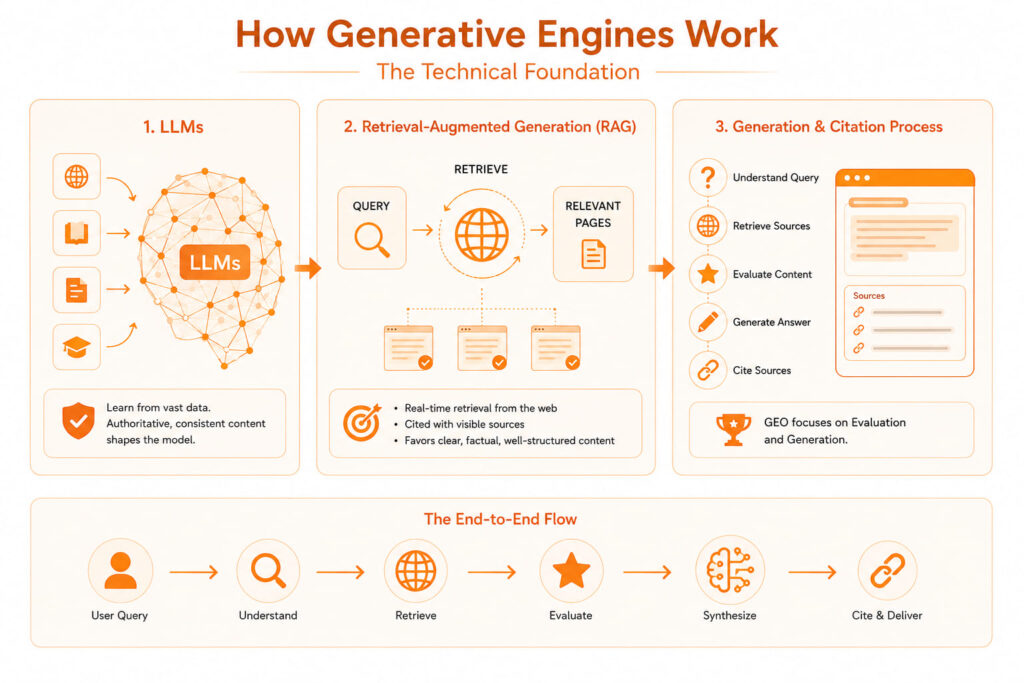
To optimise for generative engines, you must first understand how they process and select content. While each platform has unique architecture, all generative search systems share core operational components.
3.1 Large Language Models (LLMs)
Generative engines are powered by large language models — neural networks trained on vast datasets of text from the web, books, academic papers, and other sources. These models learn statistical patterns in language and use them to generate contextually appropriate, coherent responses.
For GEO, this means: content that appeared consistently authoritative, well-structured, and factually reliable in LLM training data is more likely to inform the model’s responses, even without the model explicitly citing your URL. This is why brand entity recognition and consistent online presence matter for GEO beyond just URL-based citation.
3.2 Retrieval-Augmented Generation (RAG)
Many modern AI platforms — including Perplexity, Google AI Overview, and ChatGPT with browsing — use Retrieval-Augmented Generation (RAG). In RAG systems, the AI does not rely solely on training data. It actively retrieves current web pages relevant to the query, then synthesises an answer from those retrieved documents.
RAG systems are the most directly actionable for GEO because:
- They index and retrieve content in real or near-real time
- They explicitly cite source pages with visible attribution links
- They favour pages with clear structure, direct answers, and high factual density
- Content ranking highly in Google often (but not always) appears in RAG retrieval pools
3.3 The Generation and Citation Process
When a user submits a query to a generative engine, the system follows approximately this process:
- Query Understanding — The model interprets the intent, context, and information type needed
- Source Retrieval — In RAG systems, relevant pages are fetched from the web index
- Content Evaluation — Pages are scored for relevance, authority, and answer-alignment
- Synthesis — The AI writes a response drawing from multiple evaluated sources
- Attribution — Sources cited in the response receive visible links or inline references
GEO targets steps 3 and 4 — ensuring your content scores highly in evaluation and is incorporated into the synthesised output. The technical and content requirements of GEO are specifically designed to improve your score at these stages.
Learn more about our website design services.
4. The Five Pillars of GEO
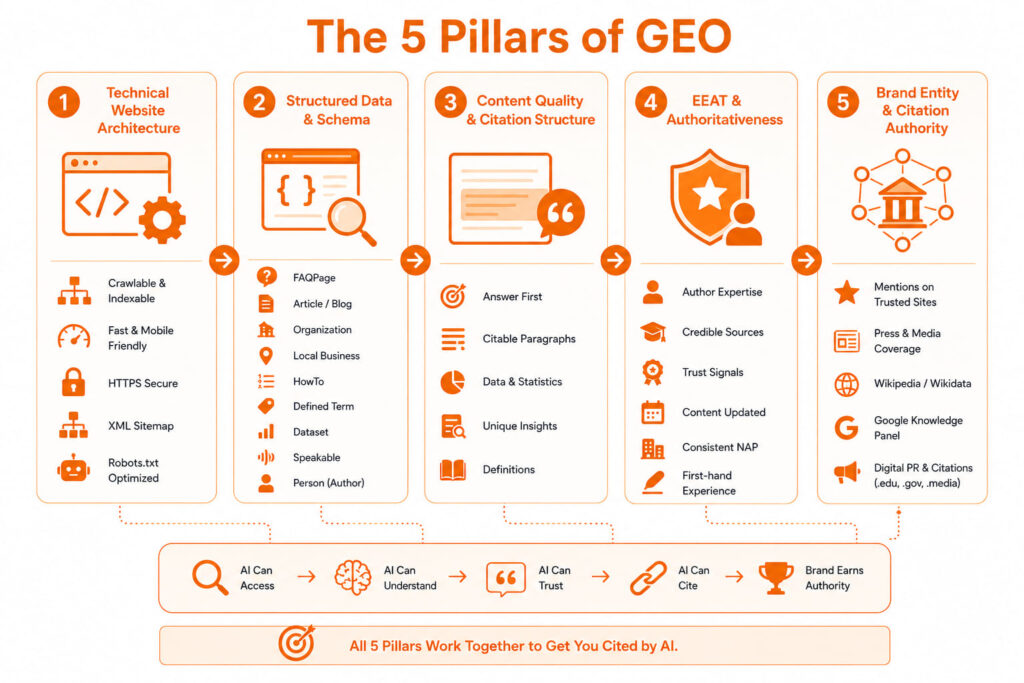
GEO is built on five interconnected pillars. A weakness in any pillar limits the effectiveness of the others. Businesses implementing GEO for the first time should assess their current performance across all five before prioritising specific tactics.
Pillar 1: Technical Website Architecture
Generative engines cannot cite content they cannot access and interpret. Technical GEO ensures your website is fully crawlable, machine-readable, and structured for AI parsing. Key requirements include:
- Semantic HTML5 with proper heading hierarchy (H1 → H2 → H3) reflecting content structure
- Fast page load speeds — LCP under 2.5 seconds, INP under 200ms, CLS below 0.1
- Full mobile responsiveness across all device types and screen sizes
- Clean, crawlable URL structures with no blocking in robots.txt for key content
- HTTPS security and valid SSL certification
- XML sitemap submitted to Google Search Console and Bing Webmaster Tools
Pillar 2: Structured Data and Schema Markup
Schema markup is the single most impactful GEO technical implementation available. It translates your content into a machine-readable vocabulary (Schema.org) that tells AI crawlers exactly what your content means — not just what it says.
| Schema Type | What It Tells AI | GEO Priority |
| FAQPage | Marks Q&A pairs as answer-ready content | 5 Stars Essential |
| Article / BlogPosting | Identifies content type, author, publish date | 5 Stars Essential |
| Organization | Establishes brand entity with contact & logo | 4 Stars High |
| LocalBusiness | Signals location, hours, services for local AI answers | 4 Stars High |
| HowTo | Structures step-by-step guides for rich results | 4 Stars High |
| DefinedTerm | Labels precise definitions for AI extraction | 4 Stars High |
| Dataset | Marks original statistics and research data | 3 Stars Medium |
| Speakable | Identifies passages for voice/audio AI delivery | 3 Stars Medium |
| Person (Author) | Builds author credibility for E-E-A-T signals | 4 Stars High |
Implementing FAQPage and Article Schema on every relevant page is the highest-ROI starting point for most businesses. These two Schema types directly improve featured snippet eligibility — which is the closest traditional-search proxy for AI citation readiness.
Pillar 3: Content Quality and Citable Structure
AI systems select content to cite based primarily on its clarity, factual density, and structural accessibility. GEO-optimised content exhibits specific characteristics that make it easy for AI to extract, quote, and attribute:
- Direct Answer First — Lead every section with the most important statement. Never bury the conclusion.
- Citable Passages — Include 2-3 clearly delineated, standalone-value paragraphs that can be extracted and quoted independently of surrounding context.
- Specific Statistics and Data — Content containing verifiable numbers, percentages, and research citations is significantly more likely to be referenced by AI platforms.
- Original Research and Insights — First-hand data, proprietary surveys, or unique expert analysis earns citations that generic content cannot.
- Definitional Sections — Clearly labelled definitions of key terms (like this guide’s definition box above) are highly extractable by AI systems.
Pillar 4: E-E-A-T and Author Authority
Google’s E-E-A-T framework (Experience, Expertise, Authoritativeness, Trustworthiness) was developed for human quality raters evaluating traditional search content — but AI models trained on Google-quality-rated data inherit these preferences. Content from demonstrably expert, verifiable authors scores higher in both traditional SERPs and AI citation selection.
E-E-A-T implementation for GEO:
- Author bio pages with professional credentials, LinkedIn profiles, headshots, and publication history
- Outbound citations to primary research, government sources, and peer-reviewed data
- Trust signals: client logos, industry certifications, awards, testimonials with names and companies
- Regular content updates with visible ‘Last Updated’ dates
- Consistent brand presence and NAP (Name, Address, Phone) data across all directories
- First-person experience signals — writing that demonstrates lived, applied expertise
See More: AI SEO: A Practical Guide to Ranking in Google AI Overviews, ChatGPT & Generative Search
Pillar 5: Brand Entity and Citation Authority
AI language models organise knowledge around entities — named things (people, organisations, locations, concepts). Building your brand as a recognised entity in the AI knowledge graph is a long-term GEO strategy that generates compounding returns.
Entity authority is built through:
- Consistent brand mention across high-authority web properties
- Appearances in industry publications, news outlets, and professional directories
- Wikipedia or Wikidata presence (where warranted by brand scale)
- Google Knowledge Panel activation and management
- Digital PR placements earning branded citations in .edu, .gov, and .media domains
5. GEO in Practice: Platform-Specific Strategies
Each major AI platform has distinct characteristics that affect how GEO should be implemented. A comprehensive GEO strategy addresses each platform’s specific selection mechanisms.
Google AI Overviews and AI Mode
Google’s AI Overview is the highest-priority GEO target for most businesses — it reaches the largest audience of any AI search platform and is integrated directly into the world’s most-used search engine. Google’s selection criteria for AI Overview content mirrors its standard quality guidelines with additional emphasis on:
- Content directly answering the query within the first 100 words of the relevant section
- Pages already ranking on page 1 (positions 1-10) for the target query
- FAQPage Schema and clearly labelled Q&A content structures
- High E-E-A-T signals, particularly for health, finance, legal, and business topics
- Comprehensive topic coverage that addresses multiple facets of a query in one resource
Perplexity AI
Perplexity is arguably the most GEO-actionable platform because it cites sources visibly and retrieves content in real-time. Its selection process strongly favours:
- Fresh, recently published content on trending queries
- Pages with high factual density — statistics, names, dates, specific claims
- Clear structure with prominent H2/H3 headings matching natural language question formats
- Content that provides multiple distinct, answerable points rather than one continuous argument
ChatGPT Search
ChatGPT’s browsing-enabled mode operates as a RAG system for current information. For GEO on ChatGPT:
- Prioritise content about topics where you have consistent, historical authority — not just recent publications
- Ensure your most important content is indexable and not hidden behind paywalls or JavaScript rendering
- Include clear, extractable definition sections that ChatGPT can paraphrase and attribute
- Build Bing presence alongside Google — ChatGPT’s browsing uses Bing’s index
Microsoft Copilot
Copilot is powered by Bing and GPT-4. For Singapore businesses, Copilot has growing enterprise relevance as Microsoft 365 users increasingly use Copilot for research. GEO for Copilot means:
- Active Bing SEO — submit to Bing Webmaster Tools and verify indexation
- LinkedIn presence and content publication — Microsoft’s ownership of LinkedIn means LinkedIn content influences Copilot’s knowledge
- Professional and B2B content that aligns with Copilot’s predominantly enterprise user base
| Want a GEO-Ready Website in Singapore? iCreationsLAB designs and builds high-performance websites with full Schema implementation, Core Web Vitals optimisation, and E-E-A-T content architecture — everything your business needs to get cited by AI search engines. www.iCreationsLAB.com | Web Design Singapore |
See More: How to Check Your Brand Visibility in AI Search
6. The GEO Content Framework: How to Write for AI Citation
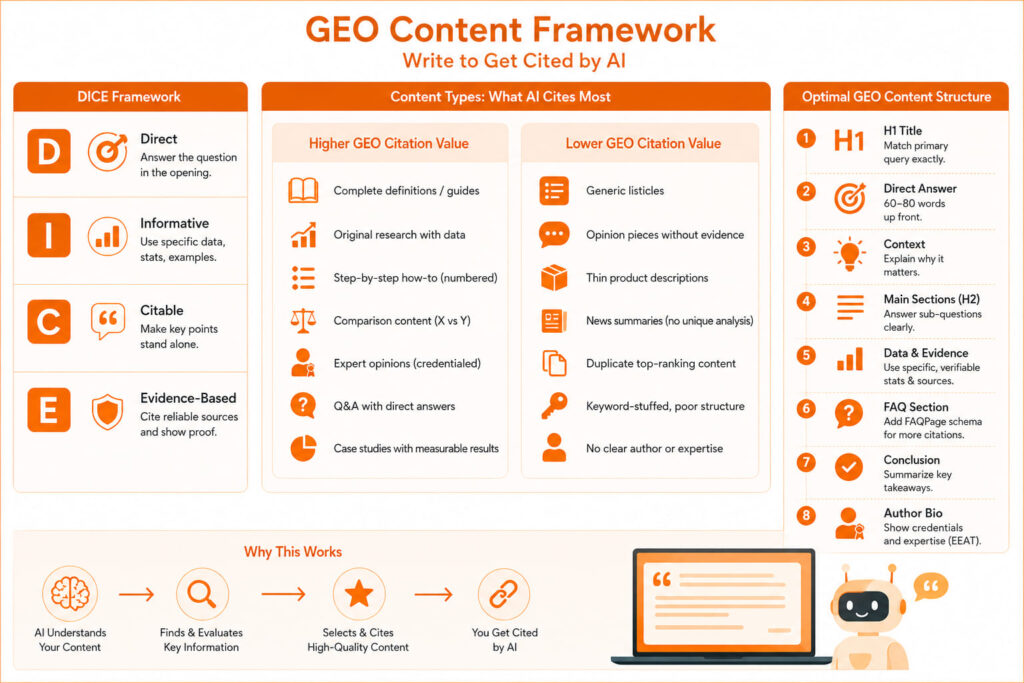
Writing for AI citation requires a specific content framework that differs from traditional SEO copywriting. The following framework — derived from the original Princeton GEO research and current best practices — provides a systematic approach to creating GEO-optimised content.
The DICE Framework for GEO Content
D — Direct: Answer the question in the opening sentence. Never make the reader (or the AI) search for the answer in the fifth paragraph.
I — Informative: Include specific data, statistics, examples, and named references. Vague generalisations are not citable. Specific claims with verifiable numbers are.
C — Citable: Structure content so key passages can stand alone. A definition, a statistic, a step-by-step process, or an expert conclusion should each be extractable without surrounding context.
E — Evidence-backed: Cite sources for factual claims. AI systems trained on quality-rated content have learned that sourced claims are more reliable. Show your work.
Content Types That Earn the Most AI Citations
| High GEO Citation Value Complete definitional guides (like this one)Original research with specific statisticsStep-by-step how-to content with numbered stagesComparison articles (X vs Y format)Expert opinion backed by credentialsFAQ sections with direct, concise answersCase studies with measurable outcomes | Lower GEO Citation Value Generic listicles without original insightOpinion pieces without supporting evidenceThin product descriptionsNews recaps without unique analysisContent duplicating existing top resultsKeyword-stuffed content with poor flowContent without clear authorship |
The Optimal GEO Content Structure
Based on current AI citation patterns, the highest-performing GEO content follows this structure:
- Article title as H1 — matches the primary query pattern exactly
- Definition or direct answer in the first 60-80 words — immediately citable
- Context and importance section — establishes why this topic matters
- Core body with H2 sections — each section answering a distinct sub-question
- Data, statistics, and evidence — specific and verifiable
- FAQ section with FAQPage Schema — multiple additional citation opportunities
- Conclusion with key takeaways — synthesised, quotable summary
- Author bio with credentials — E-E-A-T signal
See More: Website Design Cost in Singapore: Complete Pricing Guide
7. GEO for Singapore Businesses: Local Advantages and Priorities
Singapore presents a uniquely favourable environment for early GEO adoption. Several structural factors make GEO investment particularly high-return for businesses operating in the Singapore market.
First-Mover Advantage Is Real and Immediate
The majority of Singapore businesses — including large enterprises — have not yet begun systematic GEO implementation. Most digital marketing investment in Singapore remains focused on traditional SEO, Google Ads, and social media. Businesses that invest in GEO now build AI citation authority in a relatively uncrowded space, before competitors close the gap.
AI citation authority, once established, is compounding: being cited frequently trains AI models (through ongoing RLHF and training cycles) to associate your brand with specific topics, creating a self-reinforcing authority signal that becomes increasingly difficult for later entrants to displace.
High Voice Search Adoption Amplifies GEO Returns
Singapore consistently ranks among Asia’s top markets for voice assistant usage. Google Assistant, Siri, and Alexa handle significant daily query volume. Voice search is inherently a generative output — the assistant speaks one answer. GEO is the strategy that earns that answer position, making voice search ROI directly tied to GEO investment quality.
English-Language Alignment
English is Singapore’s primary business language and the dominant language of major AI platforms’ training data and retrieval systems. Singapore businesses publishing authoritative English-language content operate at the centre of AI search capability, not at its margins. This is a structural advantage over markets where AI systems are less fluent in the primary business language.
B2B and Professional Services Opportunity
Singapore’s economy is services-dominated, with significant B2B, financial services, legal, technology, and consulting sectors. These sectors are precisely the ones where AI-assisted research is most rapidly replacing traditional web search — professionals use ChatGPT and Perplexity to research vendors, compare solutions, and evaluate expertise. Being cited in these AI responses directly influences enterprise purchasing decisions.
8. GEO Implementation Roadmap
The following phased roadmap provides a practical implementation sequence for businesses beginning their GEO journey. Each phase builds on the previous, creating a compounding authority foundation.
| Phase | Focus Area | GEO Action | SEO Benefit |
| 1 — Foundation | Technical Infrastructure | Schema markup, Core Web Vitals, semantic HTML | Crawlability, rich results |
| 2 — Content | Citable Authority | FAQs, definitions, original data, direct answers | Featured snippets, topical authority |
| 3 — Authority | Entity Recognition | Digital PR, brand citations, author credentials | Domain authority, E-E-A-T |
| 4 — Optimise | Measurement & Iteration | AI citation tracking, query testing, content refresh | Rank maintenance, SERP share |
Quick Wins You Can Implement This Week
- Add FAQPage Schema to your five highest-traffic pages
- Rewrite each page’s opening paragraph to directly answer the primary query in 60 words or less
- Add an author bio with credentials to all editorial content
- Claim and complete your Google Business Profile and Bing Places listing
- Run your top 10 target queries in Perplexity and note which competitors are being cited
- Add a Definition box to your most important pillar content piece
- Audit Core Web Vitals in Google Search Console and flag failing pages for technical fixes
9. Measuring GEO Performance
GEO measurement is less standardised than traditional SEO analytics but is evolving rapidly. A practical measurement framework combines direct testing with proxy indicators:
Direct GEO Measurement
Manual AI Query Testing: Monthly, test your 20 most important queries in ChatGPT, Perplexity, Google AI Overview, and Gemini. Record which responses cite your content, how prominently, and in what context.
Perplexity Citation Tracking: Perplexity displays source links visibly. Search for your category’s key queries and audit citation frequency. This is currently the most transparent AI citation signal available.
AI Visibility Tools: Emerging tools including Profound.ai, Otterly.ai, AthenaHQ, and Semrush’s AI Toolkit automate AI citation tracking. These tools are maturing rapidly and will become standard in digital marketing stacks.
Proxy Indicators
Featured Snippet Share: The strongest proxy for GEO readiness. Track snippet ownership for target queries via SEMrush or Ahrefs. High snippet share strongly predicts AI citation frequency.
Branded Search Volume: AI citations that users never click still generate brand awareness. Monitor branded query impressions in Google Search Console as a downstream awareness signal.
Direct Traffic Trends: Brands consistently cited in AI responses typically see gradual increases in direct traffic as users who received AI-cited awareness later search directly for the brand.
Share of Voice vs Competitors: Track citation frequency relative to competitors in your category. Relative GEO performance matters as much as absolute citation volume.
See More: Top 12 Web Design Companies in Singapore (2026 Guide)
10. Common GEO Mistakes That Prevent AI Citations
As GEO adoption grows, certain implementation errors consistently prevent businesses from earning AI citations. Avoid these mistakes to maximise the return on your GEO investment:
- Burying the answer — Starting content with background context before getting to the point. AI systems prefer direct answers first; decoration and context can follow.
- Writing for keywords, not questions — GEO requires content built around the specific questions users ask AI platforms. Keyword-optimised content that does not directly answer natural language queries performs poorly in AI citation selection.
- Neglecting Schema markup — Many businesses write good content but implement no structured data. This leaves AI crawlers without explicit signals about content type, authorship, and intent.
- No original data or statistics — Generic content that aggregates widely available information has low citation value. AI systems prefer to cite sources with unique, verifiable data.
- Anonymous content — Content without clear authorship, credentials, and author entities fails E-E-A-T evaluation. All GEO-targeted content should have named, credentialed authors.
- Single-platform focus — Optimising only for Google AI Overview while ignoring Perplexity and ChatGPT leaves significant citation opportunities untapped.
- Technical barriers — GEO-optimised content on a slow, poorly-structured, or JavaScript-heavy website that is difficult to crawl will not be retrieved by AI systems regardless of content quality.
- Publishing and forgetting — AI platforms favour fresh, maintained content. Articles last updated two years ago signal potential staleness even if the information remains accurate.
Conclusion: GEO Is Not the Future — It Is the Present
Generative Engine Optimization is not an emerging trend to watch. It is an active transformation in how your customers find information, evaluate vendors, and make decisions — and it is happening right now, at scale, across every industry.
The businesses that understand GEO and act on it now will build AI citation authority during the period when competition is lowest and first-mover advantage is highest. The businesses that wait will find themselves competing in an AI citation landscape where established authorities are already deeply entrenched.
GEO is not a separate strategy from good digital marketing. It is the natural evolution of content quality, technical excellence, and brand authority — the same foundations that traditional SEO rewards, extended into the channels where your customers are increasingly spending their information-gathering time.
Begin with one page. Add a definition. Structure a FAQ. Implement Schema. Name an author. Make it fast. Make it accurate. Make it specific. Then repeat — across every page where your customers are searching for answers.
That is Generative Engine Optimization. And that is how your business gets cited in the AI era.
| iCreationsLAB Singapore’s Web Design Partner for the AI Search Era GEO begins with a technically excellent, structurally sound, and AI-readable website. Without the right foundation, even the best content will never be cited by ChatGPT, Gemini, or Google AI Overview. iCreationsLAB is Singapore’s trusted web design agency. We build websites that don’t just look great — they are engineered to be found, cited, and trusted by both human users and AI-powered search engines. Get Your Free GEO Website Audit |
Frequently Asked Questions About GEO
What does GEO stand for?
GEO stands for Generative Engine Optimization. It refers to the practice of optimising website content and technical infrastructure so that AI-powered generative search engines — including ChatGPT, Google AI Overview, Perplexity AI, and Gemini — select your content as a cited source in their AI-generated responses.
Is GEO the same as SEO?
No, but they share the same foundation. Traditional SEO focuses on ranking in search engine results pages (SERPs) to drive clicks. GEO focuses on being cited as an authority in AI-generated answers, which often occur without a click. Both require technical excellence, quality content, and authority signals — but GEO adds specific emphasis on structured data, citable content passages, and entity recognition.
How does GEO work on ChatGPT?
ChatGPT with web browsing uses a Retrieval-Augmented Generation (RAG) system that searches Bing’s index and retrieves relevant pages before generating responses. For GEO on ChatGPT, ensure your content is indexed on Bing, clearly structured with direct answers, and built around the types of questions your audience asks ChatGPT. Content that has historically ranked well for its topic is more likely to be retrieved.
How long does GEO take to show results?
GEO results vary by platform. On Perplexity AI, which retrieves content in real-time, well-optimised new content can earn citations within days to weeks. On ChatGPT and Gemini, which draw partly from LLM training data, building consistent citation authority is a longer process measured in months. Featured snippet wins — the closest traditional-search proxy — typically occur within weeks of content optimisation for pages already ranking on page one.
Does my website need to be redesigned for GEO?
Not necessarily. Many GEO improvements are content and Schema markup additions that do not require a redesign. However, if your current website has significant technical issues — slow page speed, poor mobile experience, JavaScript-heavy rendering that blocks crawlers, or no structured data implementation — a technical upgrade or redesign may be the most efficient path to GEO readiness. iCreationsLAB offers a free GEO audit to assess your current website’s readiness.
What is the most important GEO tactic to start with?
If you can only implement one GEO tactic immediately, implement FAQPage Schema with direct-answer FAQ sections on your top five pages. This single change improves featured snippet eligibility (a strong AI citation proxy), adds multiple citable passages per page, and provides structured data signals to all major AI crawlers — delivering more GEO value per implementation hour than any other single tactic.