
Buyers of industrial products and services research suppliers before they send a request for quotation. Procurement teams, engineers and project managers look for proof that you can deliver: your capabilities, equipment, certifications, past projects and a quick way to get in touch. iCreationsLab designs and builds websites for manufacturers, marine and offshore service providers, and engineering and construction-related companies in Singapore.
Who this service is for
- Manufacturers and fabricators.
- Marine, shipyard and offshore service providers.
- Engineering, construction and contracting companies.
- Industrial suppliers, distributors and trading companies with product catalogues.
What an industrial website should show
| Section | What it does for your buyers |
|---|---|
| Capabilities and services | What you can make, repair or deliver, written for your buyers’ technical needs. |
| Facilities and equipment | Your yard, factory, machinery and capacity, shown with good photographs. |
| Certifications and safety | The certifications you actually hold, such as ISO or bizSAFE, displayed clearly. |
| Projects and case studies | Real work with scope, location and outcome, where you are able to share them. |
| Products and specifications | Catalogue pages with downloadable datasheets and brochures. |
| Request for quotation | A form where buyers describe their requirement and can send supporting documents. |
| Careers | A simple page if you hire engineers, technicians or workers. |
| Contact and location | Address, map, phone and email for your office, factory or yard. |

How industrial buyers evaluate a supplier online
A purchase from a manufacturer, contractor or marine services provider is rarely made on impulse. The buyer may be an engineer checking technical fit, a procurement officer comparing several suppliers, and a manager who wants reassurance that the company is established. Each of them looks for different things, and the website has to answer all of them without making anyone dig.
What engineers look for
Technical readers want specific information: materials, tolerances, capacities, standards, equipment and typical lead times. Pages that say only that you offer “high quality solutions” give them nothing to evaluate. Where you can, describe processes and capabilities concretely and offer datasheets they can download and forward internally.
What procurement teams look for
Procurement staff want evidence that you are a safe supplier: registered business details, relevant certifications, safety practices and a clear way to request a quotation. They often compare several vendors side by side, so a page that makes your scope and contact process obvious saves them time and keeps you on the shortlist.
What decision makers look for
Senior decision makers look for signals of stability: how long you have operated, the type of facilities you run, who you have worked with and how professionally the company presents itself. A clean, current website with real photographs of your site, yard or factory does more for credibility than generic stock imagery.
Built for B2B buying
- Credibility first: a clean, professional design that matches the quality of your work.
- Easy to scan: buyers find capabilities, certifications and contact details quickly.
- Downloads that work: brochures and datasheets that are sized to open quickly.
- Secure forms: enquiry forms with consent wording and protection from spam.
- Mobile-friendly: site visits and project managers often browse on a phone.
Being found by new buyers
Many industrial buyers search for a service and a location before they contact anyone. We set up service pages around what your buyers search for, keep your business name, address and phone consistent for Google, and structure the site for search engines. With the Professional package, a 5-article setup for SEO is included. For ongoing work, see our SEO services.
Content that makes an industrial website work
Capability pages organised by what buyers need
Instead of one long “Services” page, create a page for each major capability, for example fabrication, machining, repair, installation or testing. Each page should explain what you do, which industries or equipment you serve, the standards you work to and how to request a quote. This helps buyers who search for a specific service and helps Google match your page to that search.
Certifications, shown honestly
Buyers value recognised certifications such as ISO management system standards or the bizSAFE programme for workplace safety and health. Only display certifications your company currently holds, show the certificate scope and expiry if relevant, and update the page when renewals change. An outdated certification badge can create more doubt than having none.
Project and case study pages
Past projects are among the strongest proof you can offer. A useful project page covers the client type, the requirement, what you delivered and the result, with photos. Many industrial clients have confidentiality terms, so always get written permission before naming them or showing their sites, and if you cannot name the client, describe the project type instead.
Product catalogues and downloadable documents
If you supply products, give each product or product family its own page with specifications and downloadable documents such as datasheets, brochures and, where relevant, safety data sheets. Keep file sizes reasonable and name files clearly. Search engines can index PDF documents, so well-named files can also bring in specialist searches.
Request-for-quotation forms that get complete requests
A basic contact form leads to long email chains asking for missing details. A request-for-quotation form can collect what you need up front: the type of product or service, quantity or scope, required delivery date, location and any supporting documents such as drawings. Keep the form short enough that people finish it, mark which fields are required, add consent wording for personal data, and make sure submissions reach the right person. If you need to receive drawings or larger files, tell us early so we can plan secure uploads.
Serving overseas and regional buyers
Many Singapore industrial companies serve customers across Southeast Asia and beyond. If this applies to you, keep the site in clear, simple English, show your Singapore address and operating hours with time zone, and consider adding key pages in other languages that your regional buyers use. Fast loading matters too: buyers abroad may be on slower connections and still need to open your brochures.
Our process
- Discovery and strategy: we learn about your business, audience and goals.
- UI/UX design and wireframes: page layouts and design concepts for your approval.
- Development and build: we build the site and set up your content.
- SEO and technical setup: page titles, structure, speed and tracking.
- Quality assurance testing: checks across devices and browsers.
- Launch and training: go-live and a handover so your team can manage the site.
Packages and pricing
Our website packages start from SGD 2,999. Companies with capability, project and product pages usually fit the Professional or Custom package. Corporate websites with many pages or special features are quoted after we understand your scope.
| Package | Starting price | What is included | Typical timeline |
|---|---|---|---|
| Basic | From SGD 2,999 | Ready-made design (2 options), up to 2 main pages and 5 content pages, mobile-friendly layout, basic contact form, WordPress CMS, basic security, Zoom handover training and lifetime email support. | 4 to 6 weeks |
| Professional | From SGD 4,999 | Everything in Basic plus a custom design, up to 4 main pages and 10 content pages, 5-article setup for SEO, 2 smart contact forms, 2 design revisions, and 1 year of free hosting and domain. | 6 to 8 weeks |
| Custom | From SGD 8,999 | Fully custom design with 2 concepts, up to 8 main pages and 25 content pages, 3 advanced contact forms, Google Analytics and basic tracking setup, and up to 10 AI-generated images. | 6 to 10 weeks |
Our work
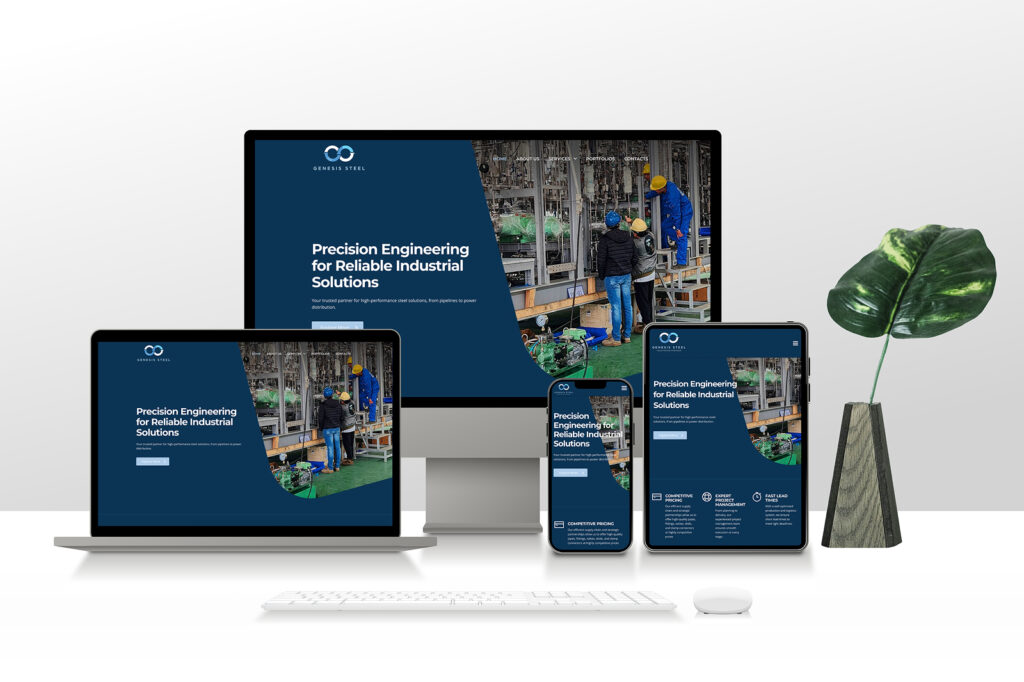
Our portfolio includes projects for PaxOcean Yard and Genesis Steel.
Frequently asked questions
How much does a website for a manufacturing company cost in Singapore?
Our website packages start from SGD 2,999 (Basic), SGD 4,999 (Professional) and SGD 8,999 (Custom). The price depends on the number of pages, design level and features, and is confirmed in a written quotation.
Can we show our certifications and safety record?
Yes. We create a clear section for the certifications you hold and display them where buyers expect to see them.
Can buyers request a quote online?
Yes. We set up a request-for-quotation form. Tell us what information and documents you need from buyers.
Can we upload new projects ourselves?
Yes. The site is built on WordPress, and we provide handover training so your team can add projects and news.
How long does it take?
Our packages are planned at 4 to 6 weeks (Basic), 6 to 8 weeks (Professional) and 6 to 10 weeks (Custom).
Do we need a product catalogue on the website?
Not necessarily. If you make custom work, a capabilities and projects section may do more for you than a catalogue. If you distribute or manufacture standard products, product pages with specifications and downloads let buyers evaluate you without waiting for a call back.
Can we protect confidential project information?
Yes. You decide what to publish. Many companies show project types and photos without naming the client, or publish only work they have permission to share. We can also keep detailed documents behind a request form instead of public links.
How will new buyers find our website?
Buyers typically search for a service, product or material together with a location, or ask colleagues for supplier names and then check the website. We build pages around the terms your buyers use and set up the technical basics for search. See our guide to SEO-driven website design for what that involves.
Do we need a bilingual or multilingual website?
It depends on who buys from you. If your customers and partners use another language for business, translated key pages can help. We can plan the structure so that more languages can be added later.
Related reading
- SEO-Driven Website Design and Development: 15 Advanced Steps to Rank Higher and Convert: How to plan a website so that buyers searching for your services can find it.
- 15 Ways to Optimize Website Size for Faster Performance: Keep brochures, photos and project pages fast to open.
- Schema Markup: Why It Matters and How It Boosts Your SEO: Help search engines understand your company, services and contact details.
| Ready to talk about your company website? Call us on +65 6269 9558 (Monday to Friday, 10am to 6pm), message us on WhatsApp or use the contact form to request a free consultation. You can also see our web design services in Singapore. |