5/5 - (4 votes)

Singapore’s digital economy is one of the most advanced in Southeast Asia. With over 4.8 million internet users and an e-commerce penetration rate surpassing 70%, the competition for visibility on Google has never been fiercer. Whether you’re running a boutique fashion store, a tech accessories shop, or a B2B supply platform, your product pages are the frontline of your online revenue engine.

Yet most Singapore e-commerce businesses make the same critical mistake: they invest heavily in social media ads and paid search, while completely neglecting organic SEO β€” the channel that delivers compounding, long-term returns without paying per click.

This guide was written by the team at iCreationsLAB, a Singapore-based web design and digital marketing agency with hands-on experience ranking e-commerce stores across highly competitive niches. By the end of this article, you will have a clear, actionable roadmap to rank your product pages on Google’s first page and turn organic traffic into real sales.

πŸ’‘ Key Insight: Why Organic Matters
β€’ 53% of all website traffic comes from organic search (BrightEdge, 2023)
β€’ First-page Google results capture over 91% of all search traffic
β€’ Organic leads have a 14.6% close rate vs. 1.7% for outbound marketing
β€’ In Singapore, ‘buy online’ searches grew 62% in the past three years

Contents

Section 1: Understanding How Google Ranks E-Commerce Product Pages

Section 1: Understanding How Google Ranks E-Commerce Product Pages

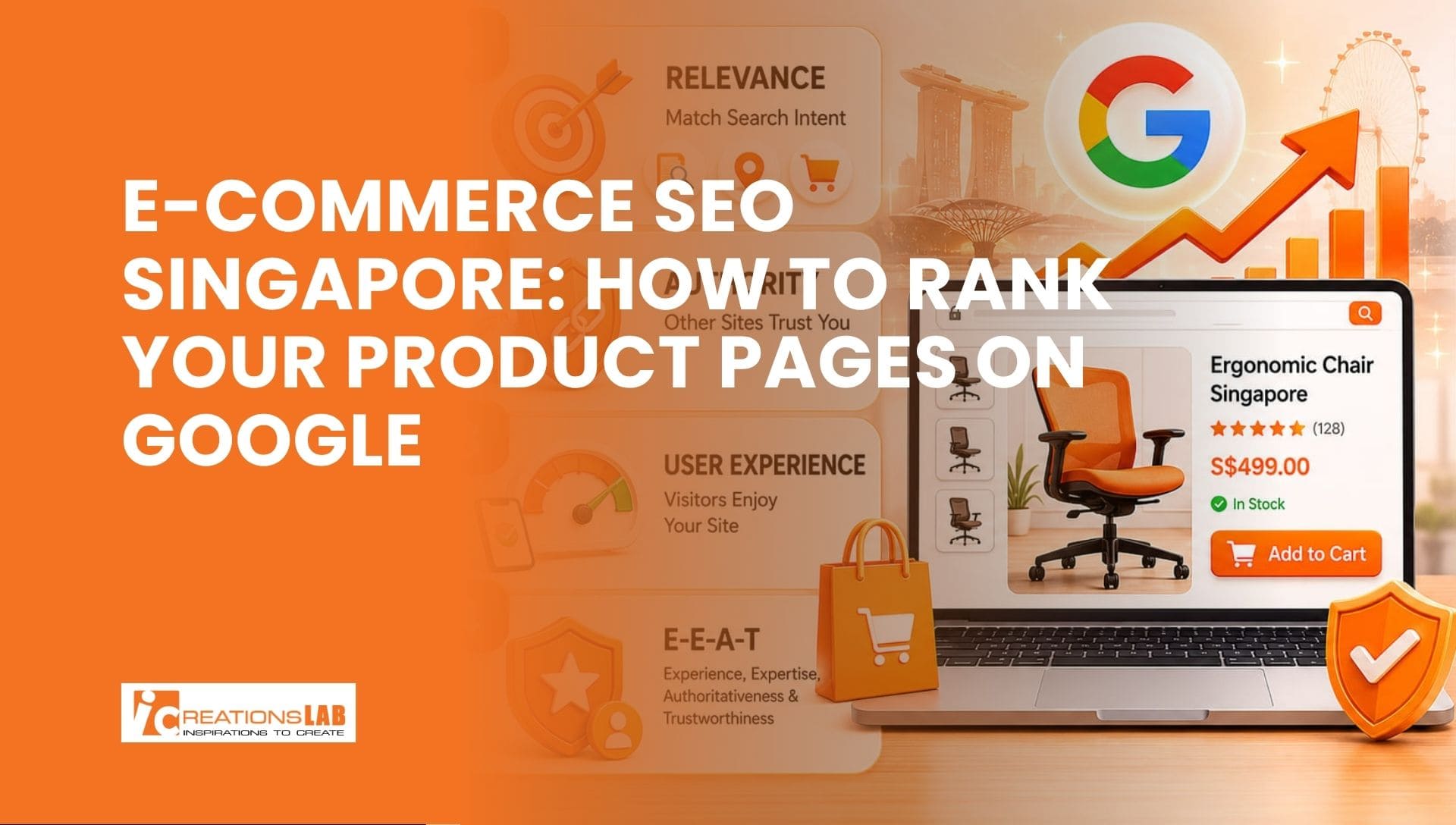
Before diving into tactics, you need to understand how Google evaluates and ranks product pages. Google’s algorithm considers hundreds of signals, but for e-commerce SEO in Singapore, four pillars matter most:

1.1 Relevance β€” Does Your Page Match Search Intent?

Search intent is the underlying reason someone types a query into Google. For product pages, there are three primary intents you must serve simultaneously:

  • Informational intent: Users researching before buying (e.g., ‘best ergonomic chair Singapore’)
  • Navigational intent: Users looking for a specific brand or store
  • Transactional intent: Users ready to buy (e.g., ‘buy ergonomic chair online Singapore’)

A high-ranking product page satisfies all three by combining persuasive copy, detailed specifications, and buying signals (pricing, availability, reviews).

1.2 Authority β€” Do Other Sites Trust You?

Google measures authority primarily through backlinks β€” links from other websites pointing to yours. For Singapore e-commerce stores, this means earning coverage from local news sites, lifestyle blogs, industry directories, and product review platforms. Authority signals that your store is legitimate, established, and worth ranking.

1.3 User Experience (UX) β€” Do Visitors Enjoy Your Site?

Google’s Core Web Vitals are now a direct ranking factor. Page speed, mobile responsiveness, visual stability, and ease of navigation all influence where your product pages rank. A technically poor site will never outrank a well-optimised competitor, regardless of how good your content is.

1.4 E-E-A-T β€” Experience, Expertise, Authoritativeness & Trustworthiness

Google’s Search Quality Rater Guidelines explicitly reference E-E-A-T as a framework for evaluating content quality. For e-commerce product pages, demonstrating E-E-A-T means showcasing real customer reviews, detailed product knowledge, transparent business information, and authoritative brand signals.

🎯Checklist for Singapore E-Commerce
βœ” Display your business address and Singapore UEN registration number
βœ” Feature verified customer reviews with photos and purchase confirmation
βœ” Include expert-written product descriptions (not manufacturer-copy)
βœ” Show author bios for blog content supporting product pages
βœ” Maintain an active social media presence linked to your domain
βœ” Secure SSL certificate (HTTPS) β€” non-negotiable in 2024
βœ” Display trust badges: MAS-compliant payment, return policy, delivery SLA

See More: E-Commerce Website Design: Boost Sales with Stunning UX and Effective Strategies

Section 2: Keyword Research for Singapore Product Pages

Section 2: Keyword Research for Singapore Product Pages

Effective keyword research is the foundation of any successful e-commerce SEO strategy. The goal is to identify search terms your ideal Singaporean customer uses when they are ready to buy β€” and then map those terms to the right pages on your site.

2.1 The Singapore E-Commerce Keyword Framework

Singapore buyers have specific search patterns. They often include geographic qualifiers (‘Singapore’, ‘SG’, ‘online delivery SG’), brand names, and comparison terms. Here is the three-tier keyword framework used by iCreationsLAB for product page optimisation:

Keyword TierExampleSearch VolumeConversion Potential
Tier 1: Head Termsergonomic chair SingaporeHigh (1K–10K/mo)Medium
Tier 2: Mid-Tailbest ergonomic chair under $500 SGMedium (100–1K/mo)High
Tier 3: Long-Tailbuy Herman Miller Aeron chair Singapore deliveryLow (<100/mo)Very High

The most effective product page SEO strategy targets Tier 2 and Tier 3 keywords first. These terms have lower competition, clearer buying intent, and faster ranking timelines β€” often 3 to 6 months versus 12+ months for head terms.

2.2 Tools for Singapore Keyword Research

  • Google Keyword Planner: Free, shows Singapore-specific volume data. Filter by country.
  • Ahrefs / Semrush: Industry-standard tools for competitor keyword gap analysis.
  • Google Search Console: Shows which queries already bring traffic to your site.
  • Google Autocomplete: Type your product into Google and note the suggestions β€” these are real queries from Singaporean users.
  • Answer The Public: Reveals question-based queries (‘how’, ‘what’, ‘best’) for FAQ content.

2.3 Analysing Competitor Product Pages

One of the fastest ways to identify winning keywords is to analyse what your competitors are already ranking for. Use Ahrefs or Semrush to:

  1. Enter a top-ranking competitor’s domain
  2. Navigate to ‘Top Pages’ or ‘Organic Keywords’
  3. Filter for product pages (URLs containing /product/ or /shop/)
  4. Export keywords they rank for in positions 4 to 20 β€” these are ‘steal-able’ opportunities
  5. Cross-reference with search intent to prioritise which pages to build first

See More: API Integration Singapore: How to Connect Your Website to Third-Party Systems

Section 3: On-Page SEO for Product Pages β€” The Complete Checklist

Section 3: On-Page SEO for Product Pages β€” The Complete Checklist

Once you have your target keywords, it is time to optimise each product page systematically. This is where most Singapore e-commerce businesses either win or lose the SEO race.

3.1 Crafting SEO-Optimised Title Tags

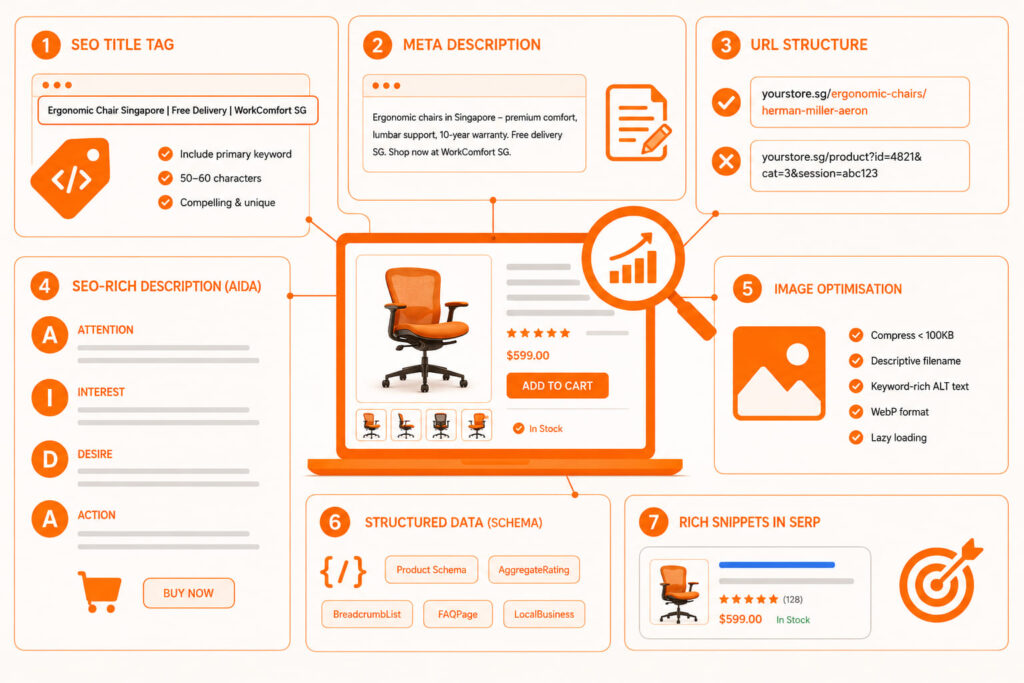
Your title tag is the most important on-page SEO element. It must include your primary keyword naturally, fit within 50 to 60 characters, and compel users to click.

βœ… Title Tag Formula for Product Pages
Formula: [Primary Keyword] | [Unique Value Proposition] | [Brand Name] Β 
Example 1: Ergonomic Chair Singapore | Free Delivery | WorkComfort SG
Example 2: Buy Herman Miller Aeron Chair Singapore | Best Price Guaranteed
Example 3: Standing Desk Singapore | Adjustable Height | Ships in 24hrs Β 
❌ Avoid: Generic titles like ‘Product Detail Page’ or keyword stuffing like ‘Chair Chair Singapore Buy Chair’

3.2 Writing Meta Descriptions That Drive Clicks

Meta descriptions do not directly influence rankings, but they significantly impact click-through rate (CTR) β€” which does influence rankings indirectly. Write unique meta descriptions for every product page. Include your keyword, a clear value proposition, and a call to action.

Template: [Primary keyword] β€” [Key benefit 1], [Key benefit 2]. [Unique selling point]. [CTA]. Free delivery in Singapore. Shop now at [Brand Name].

3.3 URL Structure Best Practices

  • Keep URLs short, descriptive, and keyword-rich
  • Use hyphens to separate words, not underscores
  • Avoid parameters and session IDs in product URLs
  • Good example: yourstore.sg/ergonomic-chairs/herman-miller-aeron
  • Bad example: yourstore.sg/product?id=4821&cat=3&session=abc123

3.4 Writing High-Converting, SEO-Rich Product Descriptions

This is where most e-commerce stores fail. Copying manufacturer descriptions is a duplicate content disaster β€” Google will not rank pages with non-unique content. Every product description must be original, keyword-optimised, and written for both humans and search engines.

The iCreationsLAB AIDA framework for product descriptions:

  • Attention: Open with the customer’s problem or desire, not with product specs.
  • Interest: Explain what makes this product unique. Include your primary and secondary keywords naturally.
  • Desire: Use sensory language, social proof references, and benefit-driven copy to build emotional desire.
  • Action: Close with a clear call to action and urgency trigger (limited stock, fast delivery, exclusive price).

Minimum word count for product descriptions: 300 words. For high-competition products, aim for 500 to 800 words with structured headers, bullet specifications, and an FAQ section.

3.5 Image Optimisation

  • Compress all product images to under 100KB without quality loss (use TinyPNG or Squoosh)
  • Use descriptive filenames: ergonomic-office-chair-singapore.jpg, not IMG_4821.jpg
  • Write keyword-rich alt text for every image: ‘Ergonomic office chair with lumbar support β€” available in Singapore’
  • Use WebP format for 30% smaller file sizes versus JPEG
  • Implement lazy loading for images below the fold

3.6 Structured Data Markup (Schema)

Schema markup tells Google exactly what your page is about, enabling rich snippets β€” star ratings, price, availability β€” in search results. These rich snippets dramatically increase CTR.

πŸ“Œ Essential Schema Types for Product Pages
β€’ Product Schema: Name, description, SKU, brand, price, availability
β€’ AggregateRating Schema: Star ratings and review count (increases CTR by up to 30%)
β€’ BreadcrumbList Schema: Helps Google understand site structure
β€’ FAQPage Schema: FAQ sections appear as expandable results in SERPs
β€’ LocalBusiness Schema: Critical for Singapore-based stores with physical locations
πŸ’‘ Need a high-converting product page? iCreationsLAB specialises in web design Singapore businesses trust to rank and convert. β†’ Visit www.icreationslab.com to learn more

See More: The Complete Guide to On-Page SEO Optimization

Section 4: Technical SEO for Singapore E-Commerce Stores

Section 4: Technical SEO for Singapore E-Commerce Stores

Technical SEO is the infrastructure that allows your content and on-page optimisation to perform. Even perfect product descriptions will not rank if your site has technical issues that prevent Google from crawling, indexing, and evaluating your pages properly.

4.1 Site Speed & Core Web Vitals

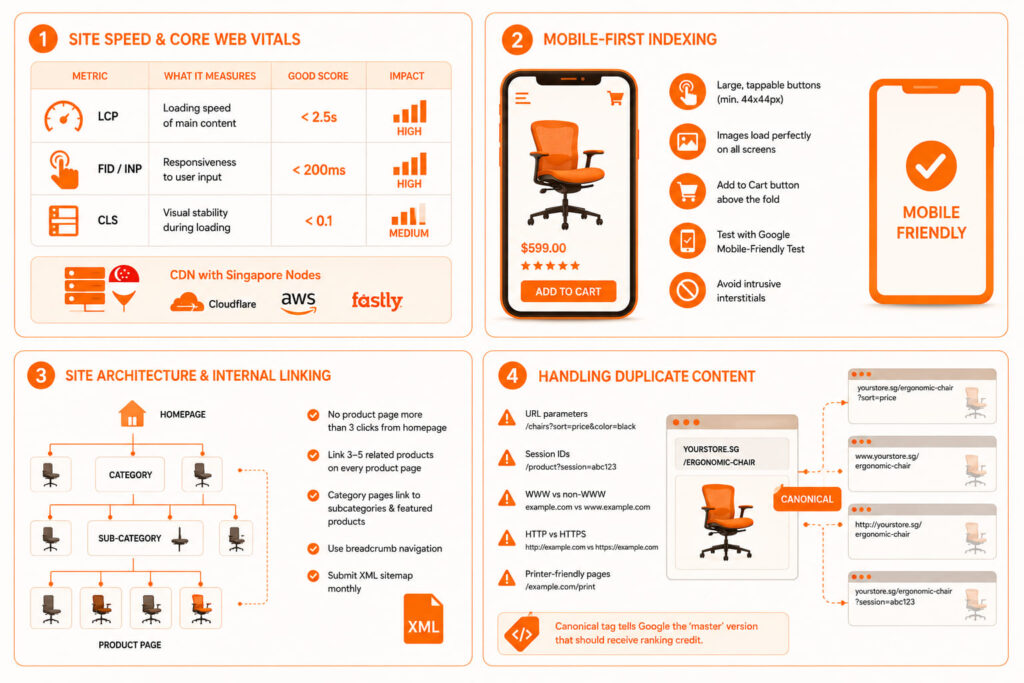
Google’s Core Web Vitals are three specific page experience metrics that directly influence rankings:

MetricWhat It MeasuresGood ScoreImpact
LCP (Largest Contentful Paint)Loading speed of main contentUnder 2.5 secondsHigh
FID / INP (Interaction to Next Paint)Responsiveness to user inputUnder 200msHigh
CLS (Cumulative Layout Shift)Visual stability during loadingUnder 0.1Medium

For Singapore e-commerce stores, a CDN (Content Delivery Network) with Singapore nodes is essential. Platforms like Cloudflare, AWS CloudFront, and Fastly all have Singapore points of presence that significantly reduce latency for local users.

4.2 Mobile-First Indexing

Google now uses the mobile version of your site as the primary version for indexing and ranking. This means your product pages must be fully optimised for mobile devices β€” not just ‘responsive’ in a basic sense, but genuinely designed mobile-first.

  • Use large, tappable buttons (minimum 44px by 44px touch targets)
  • Ensure product images load correctly on all screen sizes
  • Place the Add to Cart button above the fold on mobile
  • Test with Google’s Mobile-Friendly Test tool regularly
  • Avoid intrusive interstitials (pop-ups) that Google penalises on mobile

4.3 Site Architecture & Internal Linking

A well-structured site architecture helps Google discover and understand all your product pages. The ideal e-commerce architecture follows a flat hierarchy:

πŸ—οΈ Ideal E-Commerce Site Structure
Homepage β†’ Category Page β†’ Sub-Category Page β†’ Product Page Β 
Example: youstore.sg β†’ /office-furniture/ β†’ /ergonomic-chairs/ β†’ /herman-miller-aeron/ Β 
Key rules:
β€’ No product page should be more than 3 clicks from the homepage
β€’ Every product page should link to 3 to 5 related products
β€’ Category pages should link to subcategories and featured products
β€’ Use breadcrumb navigation on all product pages
β€’ Submit an XML sitemap to Google Search Console monthly

4.4 Handling Duplicate Content

Duplicate content is one of the most common and damaging technical SEO issues for e-commerce stores. It occurs when the same content appears at multiple URLs. Common causes include:

  • URL parameters for sorting and filtering (e.g., /chairs?sort=price&color=black)
  • Session IDs appended to product URLs
  • WWW vs. non-WWW versions of the same page
  • HTTP vs. HTTPS duplicate pages
  • Printer-friendly page versions

Solution: Implement canonical tags on all product pages. The canonical tag tells Google which version of a URL is the ‘master’ version that should receive ranking credit.

See More: The Ultimate Technical Guide to SEO-Driven Website Design and Development: 15 Advanced Steps for Ranking Higher and Maximizing Conversion

Section 5: Content Strategy to Support Product Page Rankings

Section 5: Content Strategy to Support Product Page Rankings

Product pages alone are rarely enough to dominate competitive search terms in Singapore. You need a supporting content ecosystem that builds topical authority and drives internal link equity to your most important pages.

5.1 The Hub and Spoke Content Model

The hub and spoke model β€” also known as a topic cluster strategy β€” involves creating a central ‘pillar page’ (hub) for a broad topic and supporting it with multiple detailed ‘spoke’ articles on related subtopics. All spoke articles link back to the hub, and the hub links out to relevant product pages.

Example for a Singapore ergonomic furniture store:

  • Hub: The Ultimate Guide to Ergonomic Home Office Setup in Singapore
  • Spoke 1: How to Choose an Ergonomic Chair for Long Hours of Working from Home
  • Spoke 2: Standing Desk vs. Sitting Desk β€” What Singaporean Office Workers Need to Know
  • Spoke 3: 10 Signs Your Office Chair Is Ruining Your Posture
  • Spoke 4: Ergonomic Accessories Every Remote Worker in Singapore Needs

Each spoke article naturally links to relevant product pages, channelling topical authority and driving purchase intent traffic to where it matters most.

5.2 Optimising Product-Specific FAQ Sections

FAQ sections serve a dual purpose: they answer common buyer questions (reducing friction and increasing conversions), and they target question-based long-tail keywords that often trigger featured snippets and People Also Ask boxes in Google search results.

Include at least 5 FAQ items per product page, structured as proper questions and concise answers (50 to 100 words per answer). Use FAQPage schema markup to maximise SERP visibility.

5.3 User-Generated Content as SEO Fuel

Customer reviews are one of the most underutilised SEO assets in Singapore e-commerce. A product page with 50 genuine customer reviews has significantly more unique text content than one with manufacturer copy alone β€” and that content includes natural language variations of your target keywords that real buyers actually use.

  • Set up an automated post-purchase email sequence requesting reviews
  • Display reviews prominently on product pages with schema markup
  • Respond to all reviews β€” positive and negative β€” to demonstrate engagement
  • Encourage photo and video reviews for richer content signals
  • Integrate Google Seller Ratings to show stars in your ads and organic listings

See More: How to Get Your Content to Appear in Google’s AI Overview

Section 6: Off-Page SEO β€” Building Authority for Singapore Product Pages

Off-page SEO refers to all the actions taken outside your own website to influence your rankings. For Singapore e-commerce stores, local authority signals carry significant weight.

6.1 Link Building Strategies for Singapore E-Commerce

  • Singapore Lifestyle & Review Blogs: Reach out to local bloggers and influencers in your product niche for genuine product reviews with backlinks.
  • Local Business Directories: Ensure you are listed in Singapore’s major directories: STB, SBF, SGCCI, and niche-specific trade associations.
  • PR and Media Coverage: Submit press releases to The Straits Times Digital, CNA Lifestyle, and Marketing Interactive for brand-building backlinks.
  • Supplier and Partner Pages: Ask your suppliers, brand partners, and logistics providers to link to your store.
  • HARO (Help A Reporter Out): Respond to journalist queries in your niche to earn editorial backlinks from high-authority publications.
  • Resource Page Link Building: Identify ‘best of Singapore shopping’ resource pages and request inclusion.

6.2 Google Business Profile Optimisation

For Singapore e-commerce stores with a physical presence, Google Business Profile (formerly Google My Business) is a powerful visibility tool. An optimised profile can appear in the Local Pack β€” the map section at the top of search results β€” for queries like ‘office chair shop near me Singapore’.

  • Claim and verify your Google Business Profile immediately
  • Complete all profile sections: address, hours, categories, products, services
  • Upload high-quality photos of your products, team, and premises
  • Actively collect and respond to Google Reviews
  • Post weekly updates, offers, and new product announcements
  • Add your website URL with UTM parameters to track GBP traffic

See More: Top 5 Web Design Companies in Singapore

Section 7: Tracking, Measuring & Iterating Your SEO Performance

Section 7: Tracking, Measuring & Iterating Your SEO Performance

SEO without measurement is guesswork. To build a consistently high-ranking e-commerce store in Singapore, you need a robust analytics and reporting framework that lets you identify what is working, what is not, and where to focus next.

7.1 Essential SEO Tools & Metrics

ToolPrimary UseKey Metrics to Track
Google Search ConsoleImpressions, clicks, keyword positionsCTR, average position, index coverage
Google Analytics 4Traffic behaviour and conversionsOrganic sessions, conversion rate, revenue
Ahrefs / SemrushKeyword rankings & backlink monitoringKeyword rankings, domain rating, new links
PageSpeed InsightsCore Web Vitals monitoringLCP, CLS, INP scores per page
Hotjar / Microsoft ClarityUser behaviour on product pagesHeatmaps, scroll depth, session recordings

7.2 Setting Realistic SEO Timelines for Singapore

One of the most common questions iCreationsLAB receives from Singapore e-commerce clients is: ‘How long will it take to rank on page one?’ The honest answer depends on several factors:

⏱️ Realistic SEO Timeline for Singapore E-Commerce
Month 1–2:Β Β  Technical audit, site fixes, keyword mapping, content brief creation
Month 2–4:Β Β  On-page optimisation, content creation, initial link building
Month 3–6:Β Β  First rankings appear for long-tail keywords, traffic begins growing
Month 6–9:Β Β  Mid-tail keywords start ranking, significant organic traffic growth
Month 9–12:Β  Competitive keywords enter Page 1, strong ROI becomes visible
Month 12+:Β Β  Compounding returns β€” existing rankings strengthen, new opportunities emerge Β 
⚠️ Beware of agencies promising ‘Page 1 in 30 days’ β€” this is either paid ads or unsustainable black-hat tactics.

7.3 The Quarterly SEO Audit Checklist

  1. Run a full site crawl (Screaming Frog or Sitebulb) to identify new technical issues
  2. Review Search Console for manual actions, coverage errors, or dropped rankings
  3. Audit your top 20 product pages for on-page elements and content freshness
  4. Analyse your backlink profile β€” disavow toxic links, pursue new link opportunities
  5. Review competitor rankings β€” identify pages they have gained that you have not
  6. Update product descriptions, pricing, and FAQs for seasonal relevance
  7. Check Core Web Vitals scores and address any regressions

See More: Website Design Price Guide | How Much Does It Really Cost?

Section 8: The iCreationsLAB Approach to E-Commerce SEO in Singapore

At iCreationsLAB, we believe that exceptional web design and rigorous SEO are not separate disciplines β€” they are two sides of the same coin. A beautifully designed product page that nobody finds is just as ineffective as a well-ranked page that fails to convert visitors into buyers.

Our integrated approach to web design in Singapore is built on four core principles:

  • Design for Conversion First: Every layout decision, colour choice, and CTA placement is informed by conversion rate optimisation (CRO) data and user experience research specific to Singapore’s market.
  • Build for SEO from Day One: Technical SEO is baked into the foundation of every site we build β€” not bolted on as an afterthought. Clean code, optimised site architecture, and schema markup are standard in every iCreationsLAB project.
  • Content That Earns Rankings: We craft product descriptions, category pages, and blog content that genuinely serves your customers’ needs while satisfying Google’s E-E-A-T requirements.
  • Data-Driven Iteration: We do not set and forget. Every iCreationsLAB client receives monthly SEO reporting, quarterly strategy reviews, and proactive recommendations based on real performance data.
πŸ† What Sets iCreationsLAB Apart
βœ“ Singapore-based team with deep understanding of local search behaviour
βœ“ Specialised experience in e-commerce SEO across retail, F&B, tech, and lifestyle sectors
βœ“ Full-stack capability: UX/UI design, development, SEO, and content under one roof
βœ“ Transparent reporting β€” you always know exactly where your rankings stand
βœ“ No lock-in contracts β€” we earn your business every month through results
βœ“ Certified Google Partners with proven track record in Singapore e-commerce

Conclusion: Your Roadmap to E-Commerce SEO Success in Singapore

Ranking your product pages on Google’s first page in Singapore is not a matter of luck or magic β€” it is the result of systematic, expert execution across five key areas: keyword strategy, on-page optimisation, technical SEO, content marketing, and off-page authority building.

The businesses that dominate Singapore’s e-commerce search results share a common trait: they treat SEO as a long-term investment, not a short-term tactic. They build their digital infrastructure properly from the start, create content that genuinely serves their customers, and measure their results with rigour and consistency.

If you are ready to move beyond relying on paid ads and start building an organic search engine that drives compounding, cost-efficient sales growth β€” iCreationsLAB is the partner you have been looking for.

πŸ“Š Quick-Start Action Plan: Your First 30 Days
Week 1:Β  Run a technical SEO audit using Google Search Console and Screaming Frog
Week 2:Β  Conduct keyword research for your top 10 product pages using the 3-tier framework
Week 3:Β  Rewrite product titles, meta descriptions, and descriptions for 5 priority pages
Week 4:Β  Implement Product + AggregateRating schema markup on all optimised pages Β 
Ongoing: Publish 2 supporting blog articles per month, build 5–10 quality backlinks monthly
Track:Β Β  Review Search Console weekly; run full SEO audit quarterly
πŸš€ Ready to Dominate Google Search in Singapore?
iCreationsLAB delivers results-driven Web Design & SEO services tailored for Singapore businesses.
πŸ‘‰ Get Your FREE SEO Audit Today β†’ www.icreationslab.com