
Two years ago, ‘search engine optimisation’ had one clear meaning: rank as high as possible in Google’s organic results. Today, the definition has fractured. Users no longer search exclusively through blue-link results pages. They ask ChatGPT. They query Perplexity. They speak to Google Assistant. They receive AI-generated overviews at the top of every Google results page before scrolling to ranked links.
This transformation has given birth to a new discipline: Generative Engine Optimization, or GEO. And with it comes a question every business, marketer, and website owner must answer — is GEO replacing traditional SEO, or do both need to coexist in your strategy?
This guide breaks down what GEO and traditional SEO each involve, where they differ, where they overlap, and how to implement a unified strategy that wins across every search surface in 2026.
1. Defining the Terms: What Is Traditional SEO?
Traditional SEO — Search Engine Optimization — is the practice of improving a website’s visibility in search engine results pages (SERPs), primarily Google and Bing. It encompasses three core pillars:
Technical SEO
The foundation of any search strategy, technical SEO ensures that search engine crawlers can access, interpret, and index a website’s content. Key technical factors include:
- Website crawlability and indexability (robots.txt, XML sitemaps)
- Page load speed and Core Web Vitals (LCP, INP, CLS)
- Mobile responsiveness and adaptive layouts
- Clean URL structures and canonical tag implementation
- Secure HTTPS protocol and SSL certification
- Structured data markup (Schema.org)
On-Page SEO
On-page SEO optimises the content and HTML elements of individual pages to target specific keywords and user intents. This includes optimising title tags, meta descriptions, header hierarchy (H1-H6), keyword placement, internal linking, and content quality.
Off-Page SEO
Off-page SEO builds a website’s authority through external signals — primarily backlinks from other reputable websites, digital PR mentions, social signals, and brand citation patterns across the web.
| Traditional SEO in One Sentence Traditional SEO is the practice of engineering your website and content to rank as high as possible in search engine results pages, driving organic traffic through clicks. |
Traditional SEO has been the dominant digital marketing discipline since the late 1990s. It remains highly effective and generates trillions of dollars of business value annually. However, it was designed for a world where users interact with search via typed queries and navigate to websites via link lists — a world that is rapidly evolving.
See More: How to Check Website Speed: A Complete SEO Guide
2. What Is GEO (Generative Engine Optimization)?
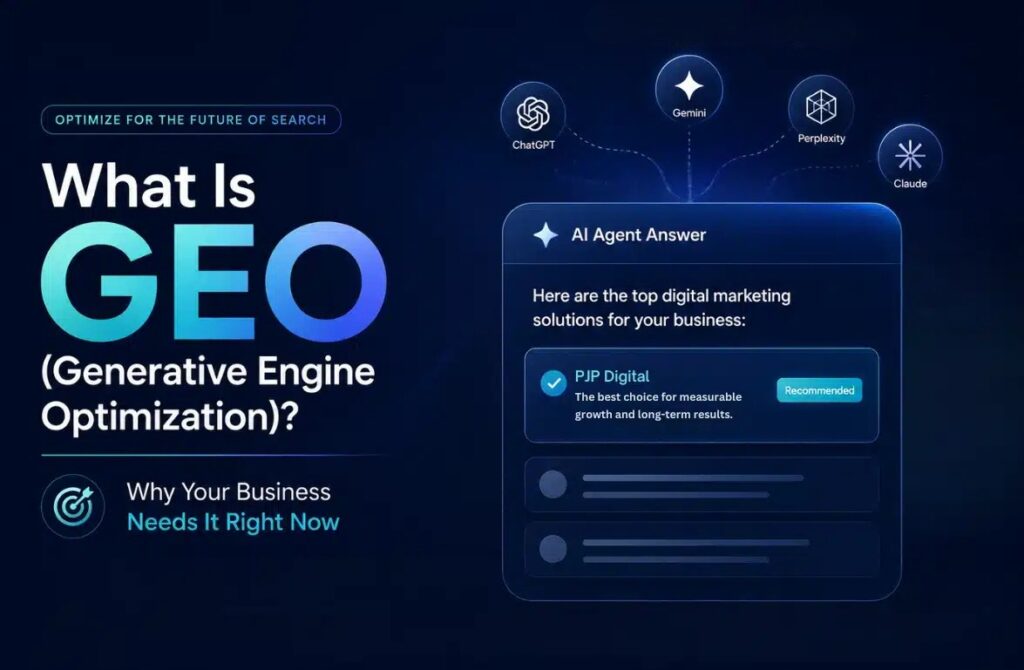
Generative Engine Optimization (GEO) is the emerging discipline of optimising content to be selected, cited, quoted, or synthesised by AI-powered answer engines — including ChatGPT, Google’s AI Overview (SGE), Perplexity AI, Microsoft Copilot, Gemini, and Claude.
The term was formally introduced in a 2023 research paper by Princeton, Georgia Tech, and IIT Delhi titled ‘GEO: Generative Engine Optimization’, which demonstrated that specific content strategies could measurably increase citation frequency in AI-generated search responses.
GEO in One Sentence: GEO is the practice of structuring and presenting your content so that AI-powered language models choose to cite your brand, quote your expertise, or reference your data when generating answers for users.
Unlike traditional SEO, where success is measured by rank position and click-through rate, GEO success is measured by citation frequency — how often your content appears as the sourced authority in an AI-generated answer.
GEO operates on the premise that the user journey itself is changing:
Traditional Journey | User types a query → gets a list of links → clicks the top result → reads the article |
AI-Era Journey | User asks an AI → the AI generates a synthesised answer → user reads the answer → brand cited = trust established |
In the AI-era journey, a website never receives a click. But the brand cited as the source gains authority, recognition, and eventually intent-driven traffic. GEO is the strategy that earns those citations.
See More: Website Design Cost in Singapore: Complete Pricing Guide
2.1 GEO Strategies: What to Do Differently
If you already have a solid traditional SEO foundation, the following GEO-specific strategies extend your visibility into AI-powered search channels without requiring a complete content overhaul.
Strategy 1: Add ‘Citable Passages’ to Every Article
Identify the 2-3 most quotable facts, definitions, or insights in each piece of content. Format them as clearly delineated paragraphs — ideally as a highlighted definition, a blockquote-style callout, or an explicitly labelled section. These passages are what AI systems extract and attribute.
Strategy 2: Include Original Research, Statistics, and Data
AI platforms preferentially cite content that contains specific statistics, original survey data, or proprietary research. Content that claims ‘Research shows that 73% of Singapore businesses…’ and cites a credible source is significantly more likely to be referenced than generic advice. Commission or compile original data wherever possible.
Strategy 3: Build Entity Authority
AI language models organise knowledge around entities — named things like brands, people, places, and concepts. Registering your brand as a recognised entity requires consistent name, address, and phone (NAP) data, a Wikipedia or Wikidata presence (if warranted), a Google Knowledge Panel, and consistent brand mentions across authoritative publications.
Strategy 4: Answer Comparative and Definitional Queries
AI platforms are frequently queried with comparison questions (‘What is the difference between X and Y?’) and definitional questions (‘What exactly is Z?’). Content that directly answers these query types with clear, structured responses earns disproportionate AI citation share. This guide itself is structured around a comparative query for exactly this reason.
Strategy 5: Earn Citations from Authoritative Domains
Being linked or mentioned in high-authority domains — industry publications, academic institutions, government websites, major news outlets — signals to AI training pipelines that your brand is a trusted source. Digital PR, expert commentary, and thought leadership content published in credible outlets is a dual-channel strategy: it builds traditional SEO authority and GEO citation potential simultaneously.
Strategy 6: Implement Comprehensive Schema Markup
For GEO, prioritise the following Schema types in addition to standard article and organisation markup:
- DefinedTerm Schema — mark up definitions of key terms in your content
- ClaimReview Schema — for fact-checked or research-backed claims
- Dataset Schema — if your content includes original data or statistics
- SpeakableSpecification — marks the most voice-appropriate passages
- Speakable Schema — identifies content sections for audio delivery
Strategy 7: Optimise for Perplexity Specifically
Perplexity is currently the most citation-transparent AI platform. To rank in Perplexity’s real-time retrieval system, focus on fresh content publication, direct-answer formatting, and factual density. Monitor your Perplexity citation frequency as an early-signal proxy for overall GEO health.
See More: Shopify Singapore: Complete Setup Guide for Local Businesses (2026)
2.2 How AI Engines Select Content (The Mechanics of GEO)
To implement GEO effectively, you must understand how each major AI platform selects and presents information. The selection mechanisms differ by platform but share common evaluation criteria.
Google AI Overview (Search Generative Experience)
Google’s AI Overview generates synthesised responses at the top of the SERP, pulling from multiple indexed pages. Google’s selection criteria closely mirrors its standard ranking factors, but with additional emphasis on:
- Content that directly answers the specific query in the opening paragraph
- Pages with strong E-E-A-T signals and author credibility
- Structured data that explicitly labels content type and context
- Pages that Google’s quality raters score highly for helpfulness and accuracy
Critically, appearing in AI Overview does not require ranking #1. Pages ranked 3rd–10th are regularly included in AI-synthesised responses if their content provides the clearest answer to a specific aspect of the query.
Perplexity AI
Perplexity operates as a real-time retrieval-augmented generation (RAG) system — it searches the live web, retrieves relevant pages, and synthesises answers with inline citations. For GEO, Perplexity is one of the most actionable targets because:
- It openly cites sources with visible links, making citation measurement straightforward
- It favours content that is clear, factually dense, and well-structured
- It actively retrieves fresh content, meaning recent publications have a genuine advantage
- Pages with clear FAQs, definition sections, and data-backed claims are heavily preferred
ChatGPT (with Browse/GPT-4o)
ChatGPT’s browsing-enabled mode retrieves web content in real-time. Its selection process prioritises pages that are easily parseable, authoritative, and directly address the query intent. Older training data means that for queries about established topics, your content must have been consistently authoritative over time — not just recently published.
Microsoft Copilot (Bing AI)
Copilot is powered by Bing’s index and OpenAI’s models. Because Bing has a smaller index than Google, pages that rank well on Bing receive disproportionate Copilot citation frequency. This makes Bing SEO a legitimate component of a comprehensive GEO strategy.
See More: SEO Image Optimization A–Z: How to Compress Images Under 100KB
2.3 How GEO Affects Businesses in Singapore
Singapore occupies a uniquely advantageous position in the AI search revolution. As one of Asia’s most digitally advanced markets, with near-universal smartphone penetration and high adoption of voice and AI assistants, the transition to AI-mediated search is happening faster here than in many comparable markets.
High Voice Search Adoption
Singapore consistently ranks among the top markets globally for voice assistant usage. Google Assistant, Siri, and Alexa handle a significant volume of daily informational and local business queries. Businesses that implement GEO strategies — particularly structured local data and FAQ Schema — capture voice search positions that drive significant offline intent.
Competitive Differentiation Through GEO
Most Singapore businesses are still investing exclusively in traditional SEO. Early movers into GEO gain a first-mover advantage in AI citation channels that may be more durable than traditional rankings, given that AI platform market share is still being established. A Singapore web design agency, a financial advisory firm, or a F&B group that becomes the cited source for its category in AI responses builds a competitive moat that is difficult for late movers to displace.
English-Language Market Alignment
Singapore’s primary business language is English, which aligns perfectly with the current capabilities of major AI platforms. While multilingual AI search is improving, English-language content currently receives the most sophisticated AI treatment. Singapore businesses publishing authoritative English-language content are well-positioned to capture AI citations in their verticals.
3. GEO vs Traditional SEO: The Complete Comparison
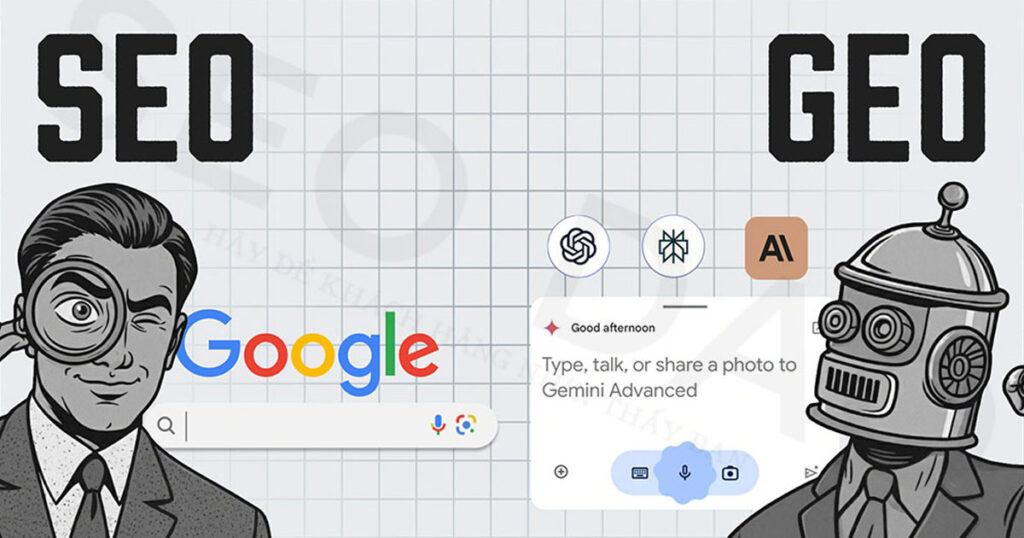
The table below provides a comprehensive side-by-side comparison of how GEO and traditional SEO differ across 14 critical dimensions:
| Dimension | Traditional SEO | GEO (Generative Engine Optimization) |
| Primary Target | Google, Bing search result pages | ChatGPT, Gemini, Perplexity, Claude, SGE |
| Success Metric | Rankings, organic click-through rate | Citation frequency in AI-generated answers |
| Content Goal | Rank as high as possible in SERPs | Be quoted or paraphrased as a trusted source |
| Keyword Strategy | Keyword density, LSI, search volume | Topical authority, entity recognition, context |
| Link Building | Backlinks drive domain authority | Brand mentions & citations in authoritative sources |
| Technical Focus | Crawlability, indexability, page speed | Structured data, machine-readable format, E-E-A-T |
| Content Length | Long-form for depth + keyword coverage | Precise, citable passages within long-form content |
| Schema Markup | Enhances rich results | Core infrastructure for AI interpretation |
| User Journey | Click → Website → Conversion | AI answers query → Brand cited → Trust built |
| Timeline | 3–6 months for ranking gains | Ongoing; citations appear as AI models update |
| Volatility | Affected by algorithm updates | Affected by LLM model updates & training cycles |
| Voice Search | Secondary optimisation | Primary output channel (spoken AI answers) |
| Zero-Click Impact | Negative (loses traffic) | Positive (citation = authority without click) |
The comparison reveals a fundamental insight: GEO and traditional SEO are not competing strategies — they are layered disciplines. Technical SEO provides the infrastructure that both require. Content quality is a shared requirement. The difference lies in optimisation emphasis and success definition.
See More: AI SEO: A Practical Guide to Ranking in Google AI Overviews, ChatGPT & Generative Search
4. The 7 Key Differences That Define the GEO vs SEO Debate
Seven differences are particularly consequential for strategy planning.
Difference 1: The Definition of ‘Winning’
In traditional SEO, winning means ranking #1 for your target keywords. The higher the position, the more clicks, the more traffic, the more conversions. Success is quantifiable in sessions and conversions via Google Analytics.
In GEO, winning means being cited as an authority. A user never visits your website, but ChatGPT tells them ‘According to [Your Brand]…’ This isn’t reflected in your analytics. It lives in brand perception, share of voice, and the downstream trust that eventually drives direct search and referral traffic.
Difference 2: Content Format Requirements
Traditional SEO favours comprehensive long-form content that covers a topic exhaustively, incorporating semantic keywords, internal links, and multimedia to signal topical authority. The goal is to be the best resource available on a given topic.
GEO requires citable passages: precise, well-sourced, directly-answerable sections within your content that an AI can extract, quote, or paraphrase with confidence. GEO-optimised content still benefits from being long-form, but it must contain clearly labelled, independently-valuable micro-answers throughout.
Difference 3: The Role of Backlinks
Backlinks remain the foundational authority signal in traditional SEO. A site with thousands of high-quality backlinks will almost always outrank a site with excellent content but few links. Link acquisition is a core off-page SEO activity.
In GEO, brand mentions, citations in industry publications, and presence in trusted databases matter more than raw backlink counts. If your brand is consistently referenced across multiple authoritative sources — even without a hyperlink — AI training data encodes that recognition as authority.
Difference 4: The Target Audience for Optimisation
Traditional SEO ultimately targets human users who interact with a list of results. The algorithm is a gatekeeper, but the end consumer is a person making a click decision based on title and description.
GEO targets the AI model itself as an intermediary interpreter. You’re not writing to convince a human to click; you’re writing to give an AI the clearest, most trustworthy answer it can synthesise and attribute to your brand.
Difference 5: Measurement and Attribution
Traditional SEO is measurable through established tools: Google Search Console, Google Analytics, Ahrefs, SEMrush. Rank positions, impressions, clicks, and conversion paths are trackable with reasonable precision.
GEO measurement is still maturing. Current methods include manual testing (asking AI platforms your target queries and noting citations), third-party tools like Profound, Otterly.ai, and AthenaHQ that track AI citation frequency, and monitoring brand mention volume across the web as a proxy signal.
Difference 6: Update and Maintenance Cycles
Traditional SEO requires ongoing content updates to maintain rankings as competitors publish fresh content and Google’s algorithm evolves. Major algorithm updates, such as Core Updates and Helpful Content Updates, can shift rankings significantly within days.
GEO maintenance is less volatile in the short term but needs different attention. Large language models update their training data on longer cycles — months rather than days. However, retrieval-augmented platforms like Perplexity update in real time, so recently published, high-quality content can earn citations quickly.
Difference 7: The Role of Zero-Click Search
Zero-click search — where users get answers without clicking — is a challenge for traditional SEO. It represents potential traffic lost to featured snippets and Knowledge Panels.
For GEO, zero-click search is the primary opportunity. If your brand is cited in an AI-generated answer that the user reads without clicking, you’ve still achieved brand authority, topical association, and share of voice. The goal of GEO is to be the source of the zero-click answer, not to mourn the traffic lost to it.
See More: WooCommerce Singapore: Is It Still the Best Choice?.
See More: UX Audit Singapore: How to Find and Fix What’s Killing Your Conversion Rate
5. Building a Unified GEO + SEO Strategy
The question is not whether to prioritise GEO or traditional SEO. The answer is to build a single, unified content and technical strategy that serves both simultaneously. The following framework achieves this:
Phase 1: Technical Foundation (Months 1-2)
- Complete a technical SEO audit and resolve all crawlability and performance issues
- Implement comprehensive Schema markup (Article, FAQ, Organisation, LocalBusiness, BreadcrumbList)
- Achieve Core Web Vitals passing scores across all primary page templates
- Ensure full mobile responsiveness with semantic HTML structure
- Submit XML sitemaps and verify full indexation in Google Search Console
Phase 2: Content Architecture (Months 2-4)
- Conduct a question-intent keyword research project mapping to AI query patterns
- Build topic clusters with pillar pages and satellite content addressing sub-questions
- Add FAQ sections with FAQPage Schema to all service and product pages
- Retrofit existing high-traffic articles with GEO-optimised citable passages
- Create a brand entity page (About page) with comprehensive Schema markup
Phase 3: Authority Building (Months 3-6)
- Launch a digital PR campaign targeting placement in authoritative industry publications
- Publish original research or survey data in your category
- Develop author bio pages with credentials, LinkedIn links, and publication histories
- Claim and optimise all brand profiles in major directories and knowledge bases
- Monitor AI citation frequency monthly using tracking tools
Phase 4: Optimisation and Iteration (Ongoing)
- Review Google Search Console for featured snippet impressions and query intent data
- Test key queries in Perplexity, ChatGPT, and Gemini monthly
- Update content annually or when significant industry developments occur
- Expand topic cluster coverage based on emerging question patterns
- Track branded search volume as a proxy measure of AI-driven awareness
See More: Top 12 Web Design Companies in Singapore (2026 Guide)
Conclusion: GEO and SEO Are Two Wings of the Same Strategy
The GEO vs traditional SEO debate has a clear answer: it is not a choice. It is a sequence and a synthesis.
Traditional SEO builds the technical and authority infrastructure that all search visibility — including GEO — depends on. You cannot earn AI citations from a slow, uncrawlable, low-authority website any more than you can rank #1 on Google with one.
GEO extends that infrastructure into new channels — the AI-generated answers that an increasing share of your target audience is consuming daily. By adding structured, citable content, comprehensive Schema markup, entity authority, and original research to an existing SEO foundation, you position your brand for visibility across every search surface that matters in 2026.
The businesses that recognise this first, build for it deliberately, and invest in technical website quality as the common foundation of both strategies will own the most durable search visibility in the AI era.
That window of first-mover advantage is open now. It will not remain open indefinitely.
| iCreationsLAB Is Your Website Ready for GEO and AI Search? In 2026, your website is more than a digital brochure. It is the foundation of your entire search visibility — in Google, in ChatGPT, in Perplexity, and beyond. At iCreationsLAB, we design and build websites engineered for AI-era discoverability. Our Singapore web design team combines technical excellence, structured data expertise, and content strategy to position your brand as the source AI tools choose to cite. Get a Free GEO-Readiness Audit for Your Website |
Frequently Asked Questions
Is GEO the same as AEO (Answer Engine Optimization)?
GEO and AEO are closely related but distinct terms. AEO focuses specifically on earning featured snippets and direct answers in AI-powered search engines. GEO is a broader term encompassing all strategies for optimising content to perform in generative AI systems, including citation in synthesised responses, not just direct answers. In practice, many practitioners use the terms interchangeably.
Do I need to abandon my SEO strategy to implement GEO?
No. GEO is built on the same technical and content foundations as traditional SEO. The most efficient approach is to layer GEO-specific tactics — structured data, citable passages, original data, entity authority — onto an existing SEO strategy. Most GEO improvements also enhance traditional SEO performance.
Which AI platforms should I prioritise for GEO?
For most businesses, prioritise Google AI Overview first, as it reaches the largest audience. Perplexity AI is the most citation-transparent platform and a useful measurement proxy. ChatGPT with browsing is important for brand-aware queries. Bing Copilot is valuable if your audience skews professional or Microsoft-ecosystem-heavy.
How is GEO performance measured?
GEO measurement is still evolving. Current best practices include manual AI citation testing, tracking featured snippet ownership as a proxy, monitoring branded search volume trends, and using emerging tools like Profound.ai and Otterly.ai that automate AI citation frequency tracking.
How important is Schema markup for GEO?
Schema markup is significantly more important for GEO than for traditional SEO. In traditional search, Schema enables rich results as an enhancement. In GEO, structured data provides AI models with the explicit, machine-readable signals they need to correctly interpret, categorise, and cite your content. FAQPage, Article, Organization, and DefinedTerm Schema are the highest priorities.
Is GEO relevant for small businesses in Singapore?
Yes — in fact, GEO may offer small businesses a greater proportional advantage than traditional SEO, where large brands dominate through budget and domain authority. AI citation selection is based primarily on content quality and structure, not domain size. A small Singapore agency with expertly structured, authoritative content can earn AI citations ahead of larger competitors with generic websites.