
SEO or SEM – A Question That Costs Businesses a Lot of Money
When businesses start doing online marketing, one question almost always comes up:
- Should we focus on SEO or Google Ads?
- Is SEO still worth it when ads can put you on top instantly?
- Should we spend money on ads or invest in long-term SEO?
The truth is, SEO and SEM are not competing strategies. The real problem is not which one to choose, but how to use the right strategy at the right time, for the right business goal.
Some companies spend thousands of dollars every month on ads but never build a brand.
Others invest heavily in SEO but struggle to generate short-term revenue.
In this guide, you will clearly understand:
- What SEO and SEM really are
- The real advantages and disadvantages of each
- When you should run paid ads
- When SEO makes more sense
- How to combine SEO and SEM for sustainable growth
If you are a business owner, marketer, startup founder, or website manager, this article is designed for you.
See More: Website Design Price Guide | How Much Does It Really Cost?
What Is SEO? Understanding Search Engine Optimization Correctly
What Is SEO?
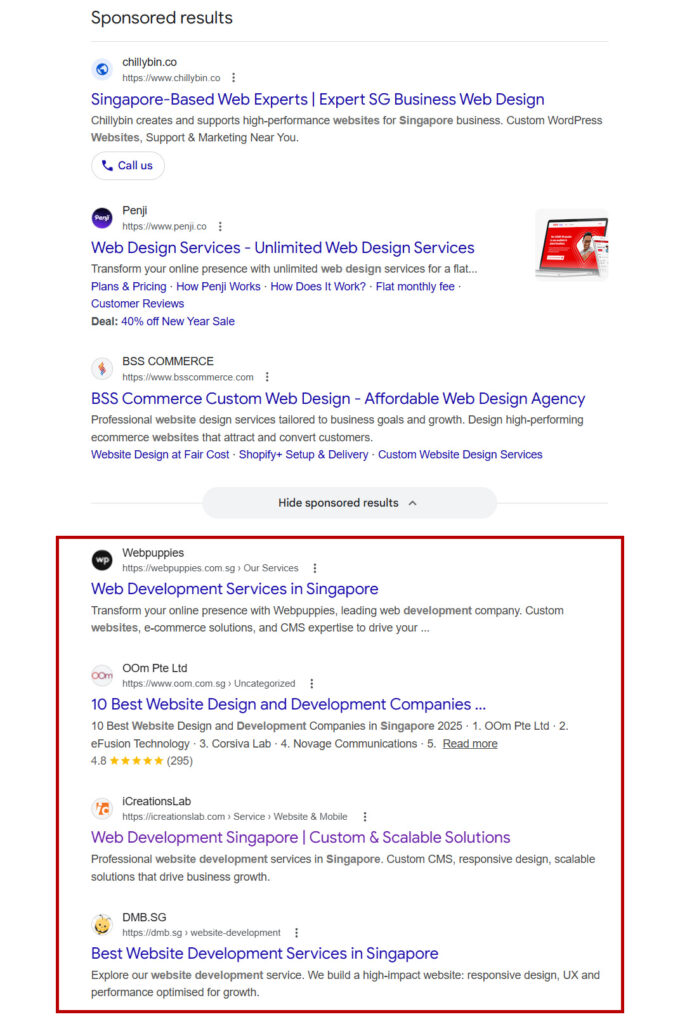
SEO (Search Engine Optimization) is the process of improving a website’s visibility in organic (non-paid) search results on search engines such as Google, Bing, and others. The goal of SEO is not simply to rank higher, but to attract the right users at the right time, based on what they are actively searching for.
In practical terms, SEO works like this:
- Users type a query into Google when they have a problem, need information, or want to buy something
- Google analyzes millions of web pages to determine which ones best match that intent
- Your website appears in the organic search results
- Users click your website
- You do not pay Google for that click
This is what makes SEO fundamentally different from paid advertising. Instead of buying traffic, SEO focuses on earning visibility by providing valuable, relevant, and trustworthy content.
At its core, SEO is about two things:
- Helping search engines understand what your website is about
- Delivering the best possible experience to users who visit your site
When these two goals align, higher rankings become a natural outcome rather than a forced result.
How Does SEO Work?
SEO is not a single technique or a one-time task. It is a long-term, multi-layered strategy that involves optimizing many aspects of a website at the same time. These efforts are usually grouped into four main areas.
Each area plays a different role, but all of them work together to determine how well a website performs in search results.
1. Content SEO: Matching Search Intent and Providing Real Value
Content is the foundation of SEO. Without strong content, no amount of technical optimization or backlinks can sustain high rankings.
Effective content SEO focuses on:
- High-quality, in-depth information
Content should fully answer the user’s question, not just scratch the surface. Google increasingly rewards pages that demonstrate real expertise and depth. - Search intent alignment
Ranking is not about keywords alone. It is about understanding why users search for a term:- Are they looking for information?
- Are they comparing options?
- Are they ready to buy?
Content that does not match intent may rank briefly but will not perform well long-term.
- Clear structure and readability
Proper use of headings, bullet points, short paragraphs, and internal links helps both users and search engines understand the content better. - Natural keyword optimization
Keywords should appear naturally within context. Modern SEO prioritizes topic relevance and semantic meaning rather than keyword repetition.
Well-optimized content does more than rank—it builds trust, keeps users engaged, and increases conversion potential.
2. Technical SEO: Making Your Website Accessible to Search Engines
Technical SEO ensures that search engines can crawl, index, and understand your website efficiently. Even the best content will struggle to rank if technical foundations are weak.
Key technical SEO elements include:
- Page speed and performance
Faster websites provide better user experiences and are favored by Google, especially with Core Web Vitals now being a ranking factor. - Mobile responsiveness
With Google’s mobile-first indexing, your website must perform well on mobile devices to rank competitively. - Core Web Vitals
Metrics such as Largest Contentful Paint (LCP), First Input Delay (FID), and Cumulative Layout Shift (CLS) measure real user experience and directly impact SEO performance. - Indexing and crawlability
Proper use of robots.txt, XML sitemaps, canonical tags, and clean URL structures ensures search engines can access the right pages. - Structured data and schema
Schema markup helps search engines better understand your content and can improve visibility through rich results.
Technical SEO does not usually generate traffic by itself, but it removes barriers that prevent your website from ranking properly.
3. User Experience (UX & UI): Turning Rankings into Results
Search engines increasingly measure how users interact with websites. This means SEO is no longer just about rankings—it is about engagement and satisfaction.
Strong UX and UI optimization includes:
- Easy-to-read layouts
Clear typography, logical spacing, and visual hierarchy improve readability and reduce bounce rates. - Clear navigation
Users should be able to find what they need quickly, without confusion or excessive clicks. - Low bounce rate and high engagement time
When users stay longer and interact more, it sends positive signals to search engines about content relevance. - Conversion-friendly design
Good UX guides users toward actions such as filling out forms, contacting your business, or making purchases.
From an SEO perspective, a good user experience reinforces ranking signals and turns organic traffic into real business value.
4. Off-Page SEO: Building Authority, Trust, and Credibility
Off-page SEO focuses on how your website is perceived outside of your own domain. Search engines use these signals to determine whether your site is trustworthy and authoritative.
Important off-page factors include:
- Quality backlinks
Links from reputable, relevant websites act as votes of confidence. Quality matters far more than quantity. - Brand mentions
Even unlinked mentions of your brand across the web help build credibility. - E-E-A-T (Experience, Expertise, Authority, Trust)
Google evaluates whether content is created by knowledgeable sources, especially for industries that impact money, health, or decision-making.
Strong off-page SEO tells search engines:
“This website is trusted by others in its industry.”
See More: Web Design Singapore: Top 5 Professional Web Design Companies
SEO Is Not About Quick Wins
SEO is not designed for instant results. It is a strategic investment that builds momentum over time. Websites that consistently follow SEO best practices tend to become stronger, more authoritative, and more resilient to algorithm changes.
In other words, SEO is about earning long-term visibility, not exploiting short-term loopholes.
Advantages of SEO
SEO is widely considered one of the most cost-effective digital marketing strategies because of its long-term impact.
Key benefits of SEO include:
- Sustainable traffic
Once your pages rank well, they can generate traffic continuously without additional cost per click. - Lower long-term marketing costs
Compared to paid advertising, SEO reduces ongoing acquisition costs over time. - Higher trust and credibility
Users generally trust organic results more than paid ads, especially for research-driven searches. - Compounding returns
Every new piece of content strengthens your website’s overall authority and ranking potential. - Reduced dependency on paid ads
A strong SEO foundation allows businesses to rely less on advertising for growth.
SEO turns your website into a long-term digital asset, not just a traffic channel.
Disadvantages of SEO
Despite its strengths, SEO is not the right solution in every scenario.
Common limitations of SEO include:
- Time-intensive results
SEO typically requires 3–6 months or longer to show significant impact, depending on competition. - Ongoing content and optimization effort
SEO is not a one-time setup; it requires continuous improvement. - Algorithm dependency
Rankings can fluctuate due to search engine updates, requiring adaptability. - Not suitable for urgent short-term goals
Businesses needing immediate leads or sales may find SEO too slow initially.
A useful analogy is this:
SEO is like building a house — it takes time, planning, and investment, but once built, it provides lasting value and stability.
See More: Best Web Design Agency In Singapore – Top Picks & Guide
What Is SEM? Understanding Search Engine Marketing in Depth
What Is SEM?
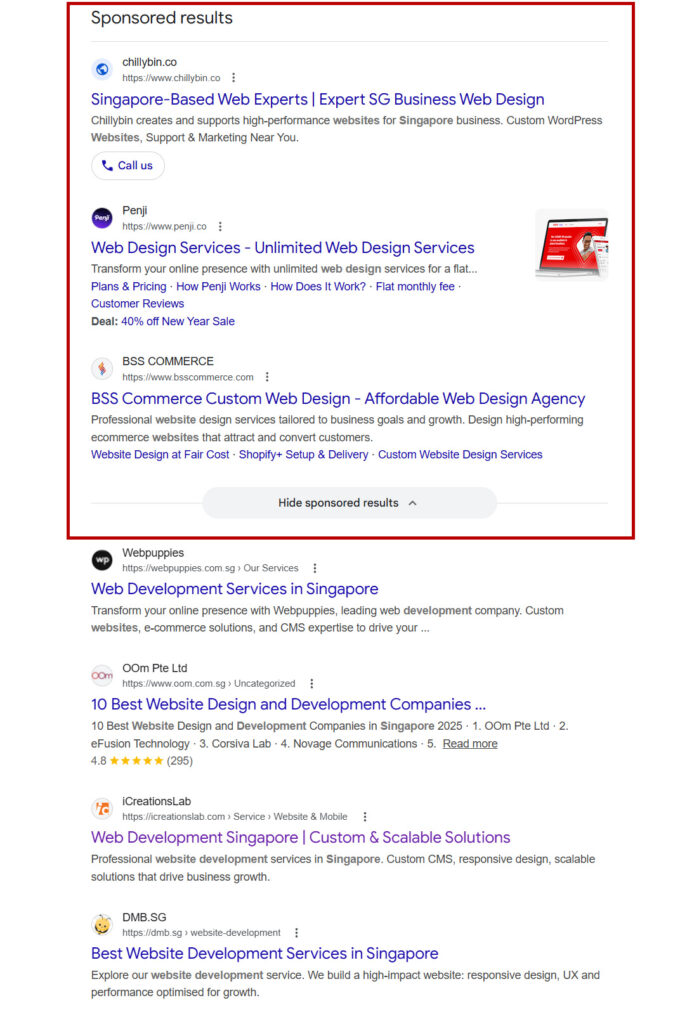
SEM (Search Engine Marketing) refers to paid advertising strategies that place your website at the top of search engine results pages (SERPs). In most cases, SEM is synonymous with Google Ads, the dominant paid search platform worldwide.
Unlike SEO, which focuses on earning visibility over time, SEM allows businesses to buy immediate exposure for specific keywords that users are actively searching for.
In practice, SEM works as follows:
- You select keywords that reflect user intent (commercial, transactional, or informational)
- You bid to compete for ad placements on those keywords
- You pay only when someone clicks your ad (Pay Per Click – PPC)
- Your advertisement appears instantly at the top or bottom of search results
In simple terms:
SEM trades money for speed and control.
This makes SEM particularly attractive for businesses that need immediate traffic, leads, or sales, rather than waiting months for organic rankings to develop.
How Does SEM Work?
SEM operates on a real-time auction system, not a simple “highest bidder wins” model. Every time a user performs a search, Google runs an instant auction to determine which ads appear and in what order.
1. The SEM Auction Process Explained
When multiple advertisers target the same keyword:
Advertisers submit bids
Each advertiser sets a maximum bid they are willing to pay for a click.
Google evaluates more than just the bid
Google calculates an Ad Rank, which is influenced by:
- Bid amount
- Quality Score
- Ad relevance
- Landing page experience
- Expected click-through rate (CTR)
Ads with the highest overall Ad Rank appear first
This means a well-optimized ad with a lower bid can outrank a poorly optimized ad with a higher bid.
This system rewards advertisers who focus on user relevance and experience, not just budget size.
2. Key Components That Determine SEM Performance
Successful SEM campaigns require mastery of several interconnected elements.
a. Keyword Research and Intent Targeting
Not all keywords are equal. Effective SEM prioritizes:
- High-intent keywords (buy, hire, pricing, services)
- Commercial and transactional searches
- Keywords aligned with specific stages of the buyer journey
Poor keyword selection leads to wasted spend, even with high traffic.
b. Ad Copy and Messaging
Ad copy must:
- Match the user’s search intent
- Clearly communicate value
- Differentiate from competitors
- Encourage action (CTA)
Well-written ads improve click-through rates, which directly impacts Quality Score and lowers cost per click.
c. Landing Page Experience
SEM does not end with the click. Google evaluates what happens after users arrive on your website.
High-performing landing pages typically:
- Load quickly
- Match ad messaging closely
- Focus on a single clear goal
- Reduce friction and distractions
- Provide trust signals (reviews, credentials, guarantees)
A poor landing page increases costs and reduces conversions, even with strong ads.
d. Continuous Optimization and Data Analysis
SEM is not a “set and forget” channel. Performance depends on:
- A/B testing ads
- Refining keyword match types
- Managing negative keywords
- Adjusting bids and budgets
- Monitoring conversion data
Advertisers who continuously optimize outperform those who simply spend more.
See More: How to Check Website Credibility Using Quick Online Tools
Advantages of SEM
SEM offers unique strengths that make it indispensable in many marketing strategies.
Key Advantages of SEM
Immediate Visibility
Ads can appear on the first page of Google within hours, making SEM ideal for businesses that need instant exposure.
Fast Lead and Revenue Generation
SEM captures users who already have intent, which often leads to:
- Higher conversion rates
- Faster sales cycles
Full Budget and Scale Control
You control:
- Daily spend
- Cost per click
- Geographic targeting
- Device targeting
- Campaign schedules
This flexibility allows precise scaling based on performance.
Highly Measurable ROI
SEM provides detailed data, including:
- Clicks
- Cost per acquisition (CPA)
- Conversion rates
- Return on ad spend (ROAS)
This makes SEM one of the most transparent marketing channels.
Ideal for Short-Term Campaigns
SEM excels in:
- Promotions and sales campaigns
- Product launches
- Seasonal offers
- Event-based marketing
Disadvantages of SEM
Despite its speed and precision, SEM has significant limitations.
Key Disadvantages of SEM
Traffic Stops When Ads Stop
Once you pause campaigns, visibility and traffic disappear immediately. There is no residual benefit.
High Costs in Competitive Industries
In markets like finance, real estate, legal services, or SaaS, cost per click can be extremely high, making SEM expensive to sustain long-term.
No Long-Term Asset Creation
SEM does not build:
- Organic rankings
- Brand authority
- Content equity
All value is temporary and paid for.
Ad Fatigue and Ad Blindness
Users increasingly:
- Ignore ads
- Scroll past sponsored results
- Trust organic content more for research
This can reduce effectiveness over time, especially in saturated markets.
Understanding SEM Realistically
SEM is not a replacement for SEO. It is a powerful accelerator, not a foundation.
A useful analogy:
SEM is like renting a house — you move in immediately, but once you stop paying rent, you lose access entirely.
Used correctly, SEM can drive rapid growth. Used alone, it can become an expensive dependency.
See More: Best Web Developer Singapore | Build Fast, Secure & SEO-Friendly Websites
SEO vs SEM: Key Differences at a Glance
| Criteria | SEO | SEM |
| Time to see results | Slow (3–6 months) | Immediate |
| Cost structure | Long-term, cost-efficient | Pay per click |
| Traffic sustainability | High | Low |
| Trust & credibility | High | Lower |
| Best use case | Long-term growth | Short-term results |
| Long-term value | Very high | Limited |
Neither strategy is inherently better — it depends on your goals.
When Should You Run SEM (Paid Ads)?
SEM is most effective when speed, predictability, and control are critical to your business objectives. It is not just about buying traffic—it is about capturing existing demand at the right moment.
Below are the situations where SEM delivers the highest return.
1. Your Website Is New and Has No Organic Visibility
New websites typically struggle with SEO because:
- They have no domain authority
- No backlinks
- No ranking history
SEO takes time to build momentum, and during this early phase, relying solely on organic traffic can severely slow down growth.
SEM solves this problem by:
- Placing your website at the top of search results immediately
- Generating leads while SEO foundations are being built
- Allowing you to validate your business model early
For startups and new businesses, SEM often acts as a bridge strategy, keeping revenue flowing while long-term SEO efforts mature.
2. You Need Immediate Revenue or Leads
SEM is the fastest channel for converting high-intent searches into revenue.
It is particularly effective for:
- Limited-time promotions
- Seasonal campaigns
- Product or service launches
- Sales-driven objectives
Unlike SEO, which builds gradually, SEM can generate results within days. This makes it ideal when:
- Cash flow matters
- Sales targets are time-sensitive
- You cannot afford to wait for organic rankings
In short, SEM is a performance-driven channel, optimized for speed and results.
3. You Operate in a Highly Competitive Market
In competitive industries, SEO alone can take many months—or even years—to reach the top positions.
SEM allows you to:
- Bypass long organic competition cycles
- Appear immediately for valuable keywords
- Capture demand that already exists in the market
This is especially useful in industries where:
- Search volume is high
- Customer intent is strong
- The cost of losing visibility is significant
While SEM may be more expensive in competitive markets, it often provides faster and more predictable returns than waiting for SEO to catch up.
4. You Want to Test Keywords, Messaging, and User Behavior
SEM is one of the most powerful tools for market and audience testing.
With paid ads, you can:
- Identify which keywords convert best
- Test different value propositions
- Measure user behavior on landing pages
- Discover what messaging resonates with your audience
These insights are invaluable for SEO because:
- High-performing paid keywords often become priority SEO targets
- Ad copy data can improve organic titles and meta descriptions
- Conversion insights inform content strategy
Used strategically, SEM becomes a research engine that feeds smarter SEO decisions.
See More: 10 Best Website Design & Development Companies 2026
When Should You Invest in SEO?
SEO is the right choice when your goal is long-term, sustainable growth rather than immediate visibility. It is best suited for businesses that view their website as a long-term asset, not just a lead source.
1. You Want Long-Term Brand Authority and Visibility
SEO helps position your brand as:
- A trusted authority
- A reliable source of information
- A consistent presence on Google
When users repeatedly see your website in organic results, it builds:
- Brand recognition
- Credibility
- Trust
Over time, SEO allows your brand to own important search topics, not just rent visibility through ads.
2. You Have a Long-Term Business Vision
SEO works best for businesses with:
- Stable offerings
- Clear positioning
- A long-term growth mindset
Because SEO compounds over time:
- Each piece of content strengthens your website
- Rankings become more resilient
- Marketing costs decrease as organic traffic grows
For businesses focused on sustainability rather than short-term spikes, SEO becomes a core growth engine.
3. You Want to Reduce Marketing Costs Over Time
One of the biggest advantages of SEO is cost efficiency at scale.
While SEO requires upfront investment, it eventually:
- Reduces reliance on paid clicks
- Lowers customer acquisition costs
- Delivers consistent traffic without ongoing ad spend
For businesses that want predictable, controllable long-term costs, SEO offers unmatched value.
4. You Operate in B2B or Knowledge-Based Industries
In B2B, professional services, and high-consideration industries, customers rarely convert after a single touchpoint.
SEO excels here because:
- Buyers research extensively before making decisions
- Informational content builds trust and expertise
- Long-form content supports complex decision-making
By answering questions and solving problems early in the buyer journey, SEO helps you influence decisions long before a sale happens.
Choosing Between SEM and SEO Is Not Binary
The most successful businesses do not ask:
“Should we choose SEO or SEM?”
Instead, they ask:
“How can SEO and SEM support each other at different stages of our growth?”
- SEM provides speed, testing, and short-term results
- SEO builds authority, trust, and long-term momentum
Used together, they form a balanced, resilient digital marketing strategy that maximizes both immediate performance and future growth.
See More: 10+ Most Important Google Algorithms
SEO or SEM? The Best Answer Is: Use Both Strategically
The most effective digital marketing strategies do not treat SEO and SEM as opposing choices. Instead, they use them together, each playing a different role depending on business goals, resources, and stage of growth.
SEO and SEM serve different purposes:
- SEM provides speed, control, and immediate visibility
- SEO builds authority, trust, and long-term sustainability
When combined correctly, they create a marketing system that delivers both short-term results and long-term growth.
How SEO and SEM Work Together Over Time
Rather than asking “Which one should we do?”, a better approach is to adjust the SEO–SEM balance as your business evolves.
Stage 1: New Website or New Business
Recommended focus:
- SEM: ~70%
- SEO: ~30%
At this stage:
- Your website has little or no organic visibility
- SEO efforts have not yet gained traction
- You need traffic, leads, or sales to validate your business
SEM plays a critical role by:
- Delivering immediate visibility on high-intent keywords
- Generating early leads and revenue
- Providing real user data (keywords, conversions, behavior)
Meanwhile, SEO efforts should focus on:
- Technical foundations
- Core service pages
- Initial content creation
Goal: Generate fast results while laying the groundwork for long-term SEO success.
Stage 2: Growing Website with Early Organic Traction
Recommended focus:
- SEM: ~40%
- SEO: ~60%
At this stage:
- Your website begins ranking for some keywords
- Organic traffic starts contributing to leads
- You have performance data to guide decisions
The strategy shifts toward:
- Reducing reliance on paid ads
- Scaling content and organic visibility
- Using SEM selectively for high-conversion keywords
SEM now supports SEO by:
- Amplifying top-performing pages
- Testing new keywords before committing to SEO
- Supporting competitive or high-value searches
Goal: Lower acquisition costs while increasing organic traffic and authority.
Stage 3: Authority Website with Strong Organic Presence
Recommended focus:
- SEO as the primary growth engine
- SEM as a tactical and scaling tool
At this stage:
- Your website ranks consistently for core keywords
- Organic traffic drives the majority of leads
- Brand authority is established
SEO becomes the foundation by:
- Owning high-value search topics
- Driving consistent, low-cost traffic
- Supporting brand trust and long-term positioning
SEM is used strategically for:
- Product launches
- Seasonal campaigns
- Retargeting
- Scaling successful offers
Goal: Achieve sustainable growth with maximum efficiency and minimal dependency on paid traffic.
See More: How to Get Your Content to Appear in Google’s AI Overview
Common SEO and SEM Mistakes Businesses Make
Even with the right tools, many businesses underperform due to strategic mistakes.
1. Running Ads Without Optimizing Landing Pages
High ad spend cannot compensate for:
- Slow pages
- Poor messaging alignment
- Weak calls-to-action
Traffic without conversion optimization leads to wasted budget.
2. Giving Up on SEO Too Early
SEO is often abandoned because:
- Results are not immediate
- Expectations are unrealistic
The biggest SEO gains usually happen after the initial slow period.
3. Focusing on Traffic Instead of Conversions
Traffic alone does not grow a business.
Without conversion tracking and optimization, even high traffic volumes produce little value.
4. Ignoring Search Intent
Ranking or bidding on keywords that do not match user intent results in:
- Low engagement
- High bounce rates
- Poor ROI
Intent alignment is more important than keyword volume.
5. Not Tracking Performance Properly
Without accurate tracking:
- Decisions are based on assumptions
- Budgets are misallocated
- Optimization becomes guesswork
Data-driven decisions separate profitable strategies from expensive experiments.
See More: Best Professional Web Design Services in Singapore
Choose the Right Strategy to Avoid Wasting Your Budget
SEO and SEM are not rivals—they are complementary pillars of digital marketing.
- SEM helps you generate leads, sales, and cash flow quickly
- SEO helps you build authority, trust, and long-term growth
Businesses that rely only on one approach often struggle with either high costs or slow results.
Smart businesses do not ask:
“Should I do SEO or SEM?”
They ask:
“Given my goals, budget, and stage of growth—how should I use SEO and SEM together to maximize ROI?”
That question is where sustainable digital growth begins.
Looking for a professional website that converts visitors into customers?
Our team provides professional website design services in Singapore tailored to your business goals.
Contact us to schedule a free consultation and explore the right solution for your brand.