
Launching a new website is one of the most common milestones for a growing business. But within days of going live, a painful truth sets in: the site is invisible. Google has not indexed it, no traffic is arriving, and the investment in design and development feels like it is sitting idle.
This is not a unique situation. The vast majority of new websites fail to gain organic visibility within their first six months — not because Google dislikes them, but because they have not been built with search in mind from the start.
At iCreationsLAB, we have been building and optimising websites for Singapore businesses since 2008. We have worked with companies across F&B, hospitality, professional services, and eCommerce, and we have seen the same avoidable mistakes made repeatedly. This guide distils everything our team has learned into ten actionable, prioritised steps — the exact framework we use when onboarding a new client website.
What you will learn: How to build an SEO foundation before launch, how to find the right keywords for your market, how to create content that ranks and converts, and how to measure progress so your investment compounds over time
1. Build Your SEO Foundation Before You Launch
Most new website owners treat SEO as something to add after the site is live. This is one of the costliest mistakes you can make. Search engine optimisation is not a layer you apply on top of a finished website — it is baked into the architecture from day one.
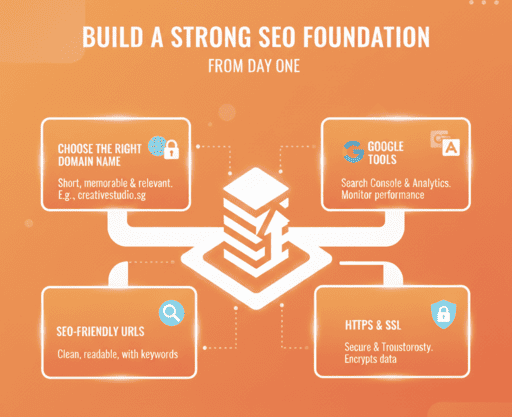
When we build a new site at iCreationsLAB, SEO considerations are present from the first wireframe. Domain selection, URL structure, site architecture, and hosting environment all affect how quickly Google crawls and indexes your pages. Getting these wrong early means spending months correcting structural debt that should never have existed.
Domain name and HTTPS
Your domain name should be short, brand-reflective, and — where genuinely natural — inclusive of a primary keyword. More importantly, it must run on HTTPS. An SSL certificate is a confirmed Google ranking factor and a trust signal users expect. Any new website launched in 2026 without HTTPS will lose trust from both Google and visitors immediately.
See More: How to Register a Domain Name in Singapore
URL structure
Clean, readable URLs improve both crawlability and click-through rates from search results. Compare these two examples:
Bad: /page?id=12&cat=3
Good: /seo-services-singapore
The second tells both Google and the user exactly what the page is about before they click. Keep URLs lowercase, use hyphens not underscores, and eliminate unnecessary parameters.
Google Search Console and Analytics
Set up Google Search Console and Google Analytics 4 on day one — before you have any traffic to measure. Search Console alerts you to crawl errors, indexing issues, and manual actions that could suppress your rankings. GA4 tracks user behaviour so you can understand what content drives engagement and conversions. Both tools are free and essential.
Site architecture
Plan your navigation and internal link structure before building. Every important page should be reachable within three clicks from the homepage. Flat site architecture distributes authority efficiently and ensures Google can discover all your pages. Siloed categories with no cross-linking waste crawl budget and dilute ranking potential.
iCreationsLAB insight: When we audited a Singapore hospitality client’s newly launched site, we found 40% of their service pages were not linked from the main navigation and had never been indexed. Six weeks after restructuring the architecture and submitting a corrected sitemap, organic impressions grew by 280%.
See More: Why Website Speed Matters for Google Ranking
2. Do Keyword Research Before Writing a Single Word
Keyword research is the difference between content that ranks and content that exists. Without it, you are writing for an imaginary audience — producing pages that answer questions nobody is actually typing into Google.
Effective keyword research has three dimensions: volume (how many people search for it), competition (how hard it is to rank for), and intent (what the searcher actually wants to find). All three must align for a keyword to be worth targeting.
Start with long-tail keywords
New websites have no domain authority. Competing for short, high-volume keywords like ‘web design’ or ‘SEO tips’ against domains that have been building authority for a decade is a losing strategy from launch day. Instead, target long-tail keywords — three to five word phrases with specific intent and lower competition.
For example, instead of ‘SEO tips’, target ‘SEO tips for new restaurant website Singapore’ or ‘how to rank a new eCommerce site on Google’. These phrases have lower search volume but far higher conversion intent and achievable ranking positions for a new domain.
Understand search intent
Every keyword falls into one of four intent categories: informational (the user wants to learn), navigational (the user wants to reach a specific site), commercial (the user is researching before buying), and transactional (the user is ready to purchase). Your content format must match the intent. A transactional keyword like ‘hire SEO agency Singapore’ should land on a services page with a clear call-to-action, not a blog post.
Tools that work
- Google Keyword Planner — free, uses real Google data, excellent for volume estimates
- Ahrefs or SEMrush — paid, but best for competitor gap analysis and keyword difficulty scoring
- Google Search Console — once live, shows you which queries are already generating impressions
- Google autocomplete and ‘People Also Ask’ — underrated free sources of long-tail ideas
Quick framework: Before creating any page, answer three questions. Who is searching for this? What do they want to find? What action do I want them to take next? A page built around clear answers to these questions will almost always outperform a page built around a keyword alone.
See More: How to Register a Domain Name in Singapore (2026 Guide)
3. Optimise Every On-Page Element with Purpose
On-page SEO is how you communicate to Google what each page is about. Done correctly, it amplifies the ranking potential of your content without requiring any external signals. Done poorly — or ignored entirely — it means even excellent content may never be surfaced.
Title tags and H1
Your title tag is the single most important on-page SEO element. It should include your primary keyword naturally, reflect the content accurately, and be written to earn a click from a search results page. Keep it under 60 characters to avoid truncation. The H1 heading on the page should echo the title tag but does not need to be identical.
Weak title: Our Services | Website Company
Strong title: Professional Web Design & SEO Services in Singapore | iCreationsLAB
Meta descriptions
Meta descriptions are not a direct ranking factor, but they directly affect click-through rate — and CTR is a behavioural signal Google does factor into rankings over time. Write a meta description that summarises the page’s value proposition in 150–160 characters, includes a natural keyword, and ends with a reason to click.
Header structure (H2–H4)
Headers break content into scannable sections and signal content hierarchy to crawlers. Use your secondary keywords naturally in H2 and H3 headings. Avoid using headers just for visual styling — every header should represent a logical content section.
Image optimisation
Every image should have a descriptive filename and an alt attribute that describes what the image shows. This improves accessibility, contributes to image search visibility, and provides additional keyword signals to Google. Compress images to their smallest acceptable quality using WebP format where possible.
Internal linking
Link relevant pages to each other using descriptive anchor text. Internal links distribute page authority, help Google understand site structure, and keep users navigating longer. When you publish a new article, go back to existing relevant pages and add a link to it.
See More: How to Submit Your Website to Google, Bing & Cốc Cốc: The Complete 2025 SEO Guide
See More: How to Check Website Speed: A Complete SEO Guide
See More: SEO Image Optimization A–Z: How to Compress Images Under 100KB
See More: SEO vs SEM Explained: When Should You Run Ads and When Should You Invest in SEO?
See More: Local SEO Singapore: How to Rank Your Business on Google Maps in 2026
4. Create Content That Demonstrates Real Experience and Expertise
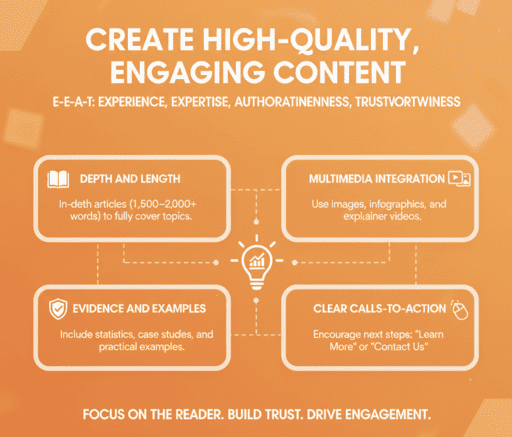
Google’s Helpful Content system and E-E-A-T guidelines have fundamentally changed what it takes to rank in 2024–2026. Generic, surface-level content — the kind that could have been written by anyone, about anything — is actively deprioritised. What rises to the top is content that demonstrates genuine first-hand experience, domain expertise, and a perspective that cannot be found elsewhere.
For a business website, this means your content must draw on your actual experience. Not just what the research says, but what you have seen, built, fixed, and learned in your own work.
Write for a specific person, not for search engines
Before writing any piece of content, define the specific person you are writing for. What do they already know? What problem are they trying to solve? What misconceptions might they have? Writing with a real reader in mind produces content that is more specific, more useful, and ultimately more likely to rank than content optimised primarily for a keyword.
Depth beats length
A 3,000-word article that fully covers a topic with examples, data, and practical guidance will outperform a 5,000-word article that repeats itself and pads with filler. Aim for completeness: answer the main question, address follow-up questions, include examples, and be honest about limitations or caveats. Google rewards pages that satisfy user intent completely, reducing the need to click back to search results.
Use original data and case studies
The single most powerful E-E-A-T signal you can add to any article is original data. Client results, before-and-after metrics, proprietary research, or even structured observations from your own work are genuinely valuable and naturally link-worthy. Nobody else can replicate your data, which means your content becomes uniquely citable.
iCreationsLAB data point: Across 50 client website relaunches between 2022 and 2024, sites that published at least four long-form (2,000+ word) articles in their first 90 days saw average organic traffic 3.4x higher at the 12-month mark compared to sites that launched with only service pages and no blog content.
Content formats that perform well
- Definitive guides — comprehensive topic coverage that becomes the go-to resource
- How-to articles with step-by-step instructions and real examples
- Comparison posts — helping users make decisions between options
- Original research and data studies — highly linkable and shareable
- FAQ pages optimised for voice search and ‘People Also Ask’ features
5. Make Site Speed a Non-Negotiable Priority
Page speed is both a direct Google ranking factor and one of the most impactful drivers of user experience. Google’s Core Web Vitals — the three metrics used to quantify loading, interactivity, and visual stability — are now part of the Page Experience ranking signal. A slow website does not just rank lower: it loses visitors before they even read your content.
According to Google’s own research, each additional second of load time increases mobile bounce probability by 32%. For an eCommerce site, a one-second delay can reduce conversions by 7%. These are not marginal improvements — speed is a fundamental business metric.
Core Web Vitals explained
Largest Contentful Paint (LCP): How long before the main content is visible. Target: under 2.5 seconds.
Cumulative Layout Shift (CLS): How much the page layout jumps around as it loads. Target: below 0.1.
Interaction to Next Paint (INP): How quickly the page responds to user input. Target: under 200ms.
Practical speed optimisation checklist
- Convert all images to WebP format and compress before upload
- Implement lazy loading for images below the fold
- Use a Content Delivery Network (CDN) such as Cloudflare to serve assets globally
- Minify CSS, JavaScript, and HTML in your production build
- Enable browser caching with appropriate cache-control headers
- Remove unused plugins and scripts — every additional HTTP request has a cost
- Use a performance-optimised hosting environment; shared hosting on overloaded servers is a common hidden bottleneck
Test your site using Google PageSpeed Insights and Lighthouse before launch. Aim for a score above 85 on mobile — the harder target, and the one that matters most for Google’s mobile-first indexing.
See More: 7 Common Web Page Design Mistakes That Drive Visitors Away
6. Build a Truly Mobile-First Website
Mobile-first is not a design trend — it is Google’s primary indexing methodology. Since 2021, Google crawls and evaluates your website’s mobile version first. Your desktop experience, no matter how polished, is secondary in Google’s ranking process.
More than 63% of searches in Singapore originate from mobile devices. If your website does not deliver a fast, frictionless experience on a 375px screen, you are losing the majority of your potential visitors at first contact.
Beyond responsive layout
True mobile-first optimisation goes further than making elements resize correctly. Consider the full interaction model: touch target sizes should be at least 48x48px to prevent mis-taps. Font sizes should be legible without zooming — a minimum of 16px for body text. Forms should use the correct input types so mobile keyboards present the right layout (email keyboard for email fields, numeric keyboard for phone numbers).
Navigation on mobile requires special attention. Complex mega-menus that work on desktop become unusable on small screens. Simplify navigation to the most important destinations and provide clear pathways to conversion actions (call, contact, book) within one tap from any page.
Avoid mobile UX pitfalls
- Intrusive interstitials — full-screen pop-ups on mobile are a negative ranking signal per Google’s guidelines
- Horizontal scrolling — content wider than the viewport causes frustration and signals poor mobile implementation
- Auto-playing video with sound — disorienting on mobile, especially in public spaces
- Tiny clickable elements grouped close together — users will tap the wrong element repeatedly
7. Strengthen Technical SEO Before Chasing Rankings
Technical SEO is the infrastructure that makes everything else possible. Even the most compelling content and the most authoritative backlinks cannot rescue a site that Google cannot crawl and index correctly. Technical issues are often invisible to the website owner but highly visible to search engine bots.
XML sitemap and robots.txt
Submit a complete XML sitemap to Google Search Console so Google knows about every page you want indexed. Your robots.txt file controls which pages crawlers should avoid — but be careful: misconfigured robots.txt files that accidentally block important pages are a disturbingly common cause of ranking loss.
Structured data and schema markup
Schema markup is code added to your pages that helps Google understand the context of your content — enabling rich results in search such as star ratings, FAQ dropdowns, event dates, and product prices. Rich results increase click-through rates significantly. Common schemas worth implementing: LocalBusiness, FAQPage, Article, Product, and BreadcrumbList.
{ “@context”: “https://schema.org”, “@type”: “FAQPage”, “mainEntity”: [{ “@type”: “Question”, “name”: “…”, “acceptedAnswer”: { “@type”: “Answer”, “text”: “…” } }] }
Canonical tags and duplicate content
If the same or very similar content appears on multiple URLs — due to filter parameters, pagination, or protocol variations — canonical tags tell Google which version is authoritative. Unresolved duplicate content issues dilute ranking signals across multiple URLs, reducing the ranking potential of each.
404 errors and redirect chains
Regularly audit your site for broken internal links (404 errors) and fix them with 301 redirects. Redirect chains — where A redirects to B which redirects to C — lose approximately 10–15% of link equity per hop. Keep redirects direct.
See More: 10 Best Website Development Companies in Singapore (2026 Ranking)
8. Build Backlinks Through Value, Not Volume
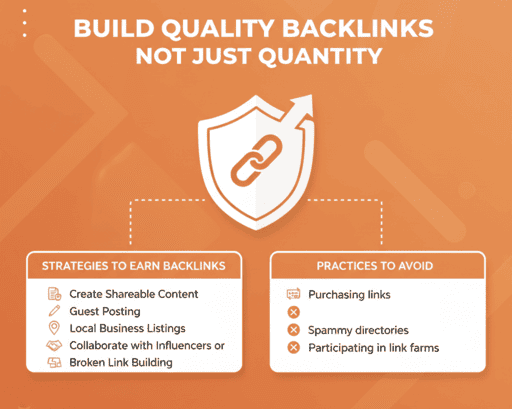
Backlinks — links from other websites to yours — remain one of Google’s most powerful ranking signals. A link from an authoritative, relevant website is an endorsement of your credibility. But the key word is quality. One link from a respected industry publication is worth more than a hundred links from low-quality directories.
New websites often fall into the trap of purchasing links or using link-building services that deliver volume without value. This is not just ineffective — it actively risks manual penalties from Google that can remove a site from search results entirely.
Earn links through content worth linking to
The most sustainable backlink strategy is creating content so useful, original, or data-rich that other websites naturally want to reference it. Original research, comprehensive guides, free tools, and authoritative data studies all earn links organically. This is also the approach that compounds: the same content keeps attracting links years after publication.
Practical link-building tactics for new websites
- Guest posting on relevant industry publications — write genuinely valuable content, not thinly veiled advertisements
- Local business listings — submit to Google Business Profile, Singapore business directories, and industry-specific registries
- Digital PR — share newsworthy data or insights with journalists and bloggers in your space
- Partner and supplier pages — ask business partners you already have relationships with to link to your site
- Broken link building — find broken links on relevant sites and offer your content as a replacement using Ahrefs or Check My Links
What to avoid: Paid link schemes, private blog networks (PBNs), excessive reciprocal linking, and low-quality directory submissions. Google’s Spam Policies explicitly target these tactics and their detection has improved significantly with AI-based algorithms.
9. Use Analytics to Make Decisions, Not Assumptions
SEO without measurement is guesswork. The reason so many websites stagnate after an initial effort is that owners make content and optimisation decisions based on assumptions — what they think is working, what they assume people want — rather than what the data actually shows.
Two free tools give you everything you need to make intelligent, data-driven decisions from day one.
Google Search Console — your SEO dashboard
Search Console shows you every query that generated an impression of your website in Google Search, the average ranking position for each query, the click-through rate, and the pages receiving the most search exposure. This data is available weekly and lets you identify exactly which keywords are close to ranking well (positions 8–15) and should be prioritised for optimisation.
Google Analytics 4 — your user behaviour dashboard
GA4 shows you what happens after users arrive: which pages they visit, how long they stay, where they drop off, and whether they complete conversion actions. The combination of Search Console and GA4 creates a complete picture — from query to click to conversion — that should drive every SEO decision.
Key metrics to track monthly
- Organic traffic (total sessions from search, trend over time)
- Impressions and average position for target keywords (Search Console)
- Click-through rate by page — low CTR on high-impression pages signals title/description issues
- Core Web Vitals scores (Search Console > Experience > Core Web Vitals)
- Pages with declining rankings — catch drops early before they compound
- Crawl errors and indexing status — ensure all important pages are indexed
See More: 5 Best Website Builders for Small Business in 2026 — Comprehensive List & Reviews
10. Commit to SEO as a Long-Term Business Strategy
SEO is not a campaign with a start and end date. It is a compounding business asset that grows in value over time — but only with consistent investment. The websites that dominate search results in any industry are not there because of a burst of activity in one quarter. They are there because they have published consistently, maintained technical health, and earned authority steadily over months and years.
New websites should set realistic timeline expectations. Meaningful organic traffic for competitive keywords typically begins to appear between 6 and 12 months after launch for a well-optimised site. Some industries are more competitive than others. Some keywords are reachable within weeks; others require years of sustained effort.
The compound effect of SEO
Unlike paid advertising, which stops delivering the moment you stop paying, SEO value accumulates. A well-written article published today may rank in position 8 this month, position 4 in six months, and position 1 in a year — continuing to generate traffic without additional spend. This is why early investment in content quality and technical foundations delivers disproportionate long-term returns.
Long-term SEO habits that matter
- Audit and refresh top-performing content every six months — update statistics, add new examples, improve depth
- Conduct a technical SEO audit at least twice per year using Screaming Frog or Ahrefs Site Audit
- Monitor Google algorithm updates and assess their impact on your rankings within 2–4 weeks of each rollout
- Build content clusters — a pillar page covering a broad topic, supported by cluster articles covering sub-topics
- Invest in conversion rate optimisation alongside SEO — more traffic is only valuable if it converts
iCreationsLAB perspective: Of the hundreds of websites we have worked on since 2008, the most successful have one thing in common: the business owner treats SEO as infrastructure, not marketing spend. They invest in it consistently, measure it rigorously, and think in 12-month cycles rather than 30-day campaigns.
See More: Custom UI UX Design Solutions for Businesses in 2025
Bonus: Integrate SEO with Your Broader Marketing Strategy
SEO does not exist in isolation. The most effective digital marketing strategies treat search optimisation as the backbone that amplifies every other channel.
- Blog posts, guides, and case studies created for SEO also serve as social media content, email newsletters, and sales collateral — one piece of content, multiple distribution channels.Content marketing:
- While social signals are not a direct ranking factor, social distribution accelerates content discovery and increases the likelihood of earning backlinks from people who encounter your content.Social media:
- Driving repeat visits from email subscribers increases engagement signals — session duration, pages per visit, return visits — that indirectly support SEO performance.Email marketing:
- Paid search data from Google Ads reveals which keywords convert best, providing valuable intelligence to prioritise in your organic SEO strategy.PPC advertising:
Ready to Build a Website That Ranks?
The success of your website depends heavily on how effectively you implement SEO strategies from the beginning. Applying these 10 essential SEO tips will help your new website:
- Drive consistent organic traffic
- Improve user experience across devices
- Achieve higher rankings in search results
- Increase conversions and overall ROI
SEO is not just about ranking; it is about creating a website that delivers value, speed, and trust to your visitors. For optimal results, consider partnering with a professional agency that combines technical SEO, content strategy, and web design expertise.
About iCreationsLAB
Established in 2008, iCreationsLAB is a leading web design and SEO company based in Singapore. We specialize in helping businesses transform their websites into high-performing digital assets.
Our Services Include:
- Web Design & Development
- eCommerce Website Solutions
- SEO & Content Marketing
- Web Applications and Custom CMS Development
By combining design, technology, and SEO strategy, iCreationsLAB ensures your website not only looks professional but also ranks effectively and drives measurable business growth.
Contact us to schedule a free consultation and explore the right solution for your brand.