
Search has fundamentally changed. Today, users often receive direct answers from Google, ChatGPT, Gemini, and Perplexity without needing to click a website.
This shift has created a new discipline: Answer Engine Optimization (AEO) — the practice of optimising content so AI-powered search engines can find, understand, and cite it as a trusted source.
For businesses, e-commerce brands, and content publishers, AEO is becoming essential. In this guide, you’ll learn what AEO is, why it matters in 2026, how it differs from traditional SEO, and the key strategies to help your content become the answer users see first.
1. Answer Engine Optimization Defined
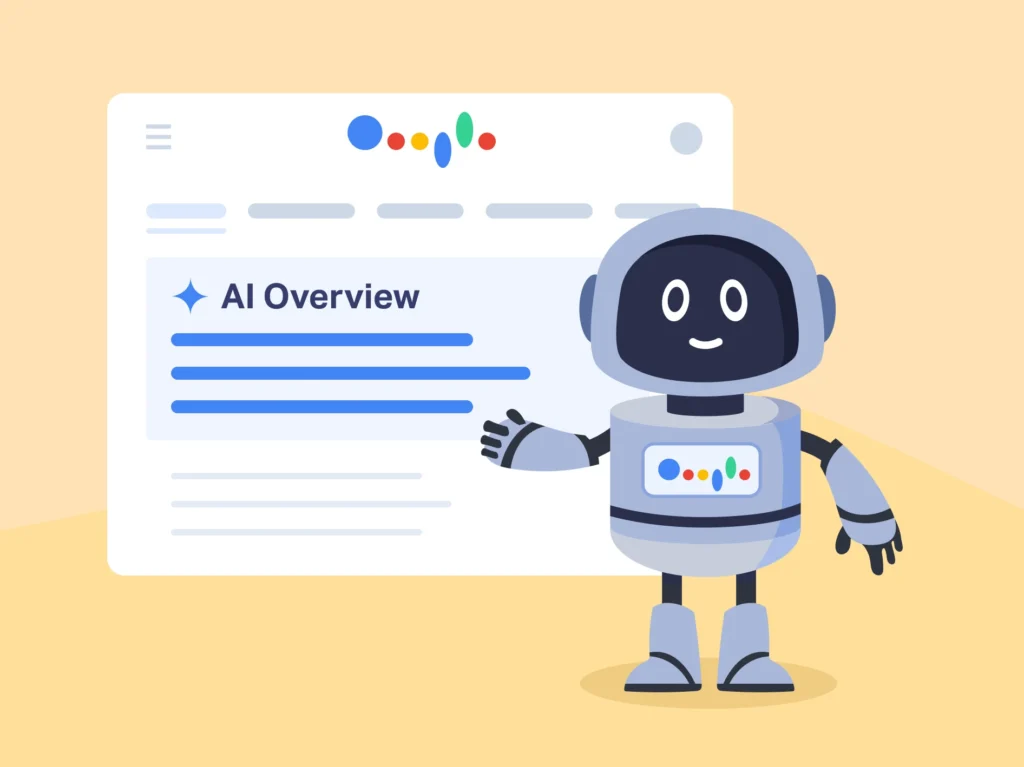
Answer Engine Optimization (AEO) is the practice of structuring, formatting, and optimising your digital content so that it is selected as the direct answer by AI-powered search engines, voice assistants, and large language models (LLMs) such as ChatGPT, Google’s Search Generative Experience (SGE), Bing AI, Perplexity, and Amazon Alexa.
Unlike traditional SEO, which focuses on ranking as highly as possible in a list of blue links, AEO focuses on winning the answer — the singular, authoritative response that an engine delivers to a user’s question without requiring a click.
| Definition: Answer Engine Optimization (AEO) AEO is the strategic process of creating and structuring content to satisfy the intent behind natural language and conversational queries, positioning your brand as the trusted source that AI tools, voice search assistants, and featured snippet algorithms choose to quote, cite, or directly deliver to users. |
AEO encompasses a range of techniques including:
- Crafting direct, concise answers to frequently asked questions
- Implementing structured data markup (Schema.org) to make content machine-readable
- Optimising for voice search and conversational query patterns
- Building topical authority through comprehensive, expert-level content
- Earning E-E-A-T signals (Experience, Expertise, Authoritativeness, Trustworthiness)
- Technical website performance that satisfies AI crawlers and quality signals
See More: What Is GEO (Generative Engine Optimization)? A Complete Guide for Businesses
2. Why AEO Matters More Than Ever in 2026
The rise of AEO is not a trend. It is a structural shift in how billions of people access information. Consider the following developments that make AEO essential for any business operating online:
2.1 Zero-Click Searches Are Dominating
Studies consistently show that more than 65% of Google searches now result in zero clicks — the user gets their answer directly on the search results page and never visits a website. Featured snippets, Knowledge Panels, People Also Ask (PAA) boxes, and Google’s AI Overviews all contribute to this phenomenon.
For businesses, this means: if your content is not the answer, you receive no traffic from that query — regardless of how well you rank. AEO is the strategy that turns zero-click search into brand visibility and authority.
2.2 AI Assistants Are Replacing Traditional Search
ChatGPT crossed 200 million weekly active users in 2024. Perplexity AI grew 400% year-over-year. Google’s Gemini and Microsoft’s Copilot are embedded directly into billions of devices. These tools do not return a list of websites — they return answers. Your content either influences those answers or it does not exist in that channel.
2.3 Voice Search Is Now Mainstream
Smart speakers, smartphones, and in-car assistants handle billions of voice queries daily. Voice search is inherently conversational and question-based. When someone asks their Google Home ‘What is the best web design agency in Singapore?’, the device reads one answer aloud. AEO is the discipline that earns that position.
2.4 Search Intent Has Shifted to Conversational
Modern users do not search for ‘AEO’. They ask ‘What is Answer Engine Optimization and how do I use it?’ This shift from keyword-based to intent-based, natural language queries is the core driver of AEO as a distinct practice from SEO.
See More: E-Commerce SEO Singapore: How to Rank Your Product Pages on Google
3. AEO vs SEO: What Is the Difference?
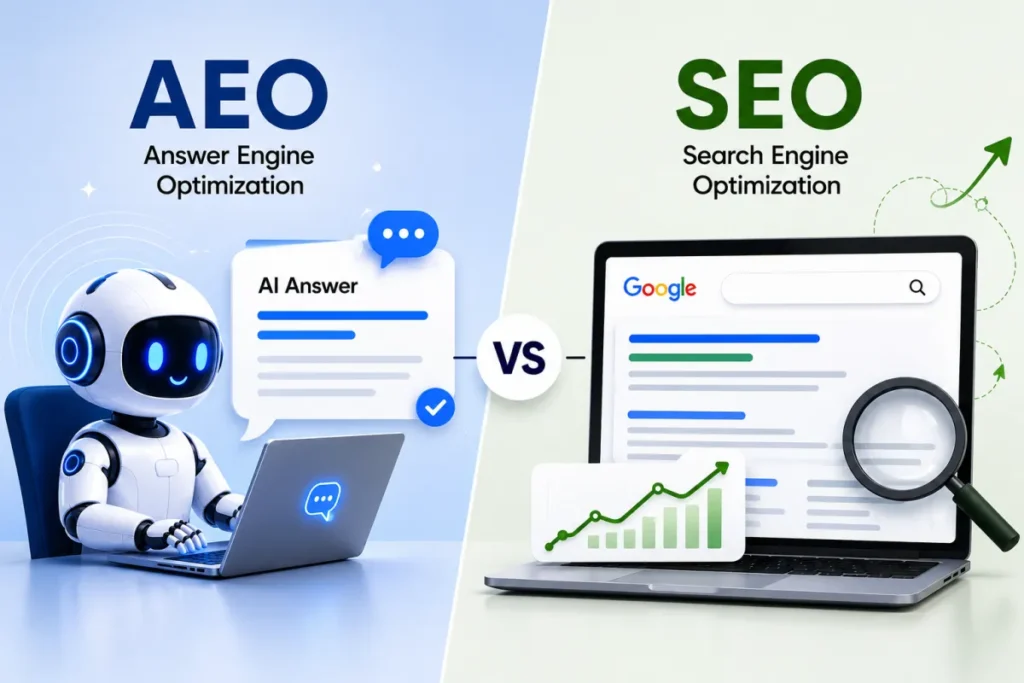
AEO and SEO are complementary, not competing strategies. However, understanding their differences helps you allocate effort correctly and build a content strategy that performs across all discovery channels.
| Feature | Traditional SEO | Answer Engine Optimization (AEO) |
| Primary Goal | Rank on page 1 of Google | Be the direct answer in AI/voice results |
| Content Format | Keyword-dense long-form articles | Structured Q&A, concise, authoritative snippets |
| Target Query | Short & long-tail keywords | Conversational & question-based queries |
| Success Metric | Click-through rate, rankings | Featured snippet wins, zero-click authority |
| Schema Markup | Optional enhancement | Essential requirement |
| Voice Search | Secondary consideration | Core optimization target |
| AI Platforms | Not applicable | ChatGPT, Gemini, Perplexity, Bing AI |
The key insight is that SEO and AEO share the same foundation — quality content, technical excellence, and authoritative backlinks — but diverge in their emphasis. SEO prioritises ranking; AEO prioritises being chosen as the definitive answer.
For businesses in Singapore and Southeast Asia, where mobile usage and voice search adoption are among the highest in the world, AEO is not an advanced tactic. It is a baseline requirement for competitive search visibility.
See More: GEO vs Traditional SEO: What’s the Difference?
4. How Do Answer Engines Work?
To optimise for answer engines, you must first understand how they evaluate and select content. The process differs across platforms but shares common principles.
4.1 Google’s Featured Snippets & AI Overviews
Google extracts featured snippet content algorithmically by identifying passages on indexed pages that directly and concisely answer a user’s query. Google’s criteria for snippet selection prioritises:
- Content that directly answers the question in the first sentence or paragraph
- Pages with strong topical authority and backlink profiles
- Proper use of headers, structured lists, and tables
- Schema markup that labels content types explicitly
- High E-E-A-T scores, especially for YMYL (Your Money or Your Life) topics
Google’s AI Overviews (formerly Search Generative Experience) go further, synthesising content from multiple sources to generate a comprehensive answer, citing contributing pages with links.
4.2 Large Language Models (ChatGPT, Gemini, Perplexity)
LLMs are trained on vast datasets of web content and generate answers by predicting likely, accurate responses based on patterns in their training data and, in retrieval-augmented systems, by fetching live web content. For your content to influence LLM responses:
- It must be publicly accessible and indexable by web crawlers
- It must be consistently cited as authoritative across multiple web sources
- It must be structured clearly enough for parsing and summarisation
- It must align with factual consensus and avoid contradictory claims
Perplexity, in particular, operates as a real-time retrieval engine that cites sources directly. Being cited by Perplexity is a direct signal of AEO success.
4.3 Voice Assistants (Alexa, Siri, Google Assistant)
Voice assistants typically pull featured snippet content or local business data from Google My Business. For voice AEO, the priority is featured snippet optimisation, local SEO, and FAQ schema implementation. Answers must be audible — clear, concise, and free of visual formatting that does not translate to speech.
See More: Top 12 Web Design Companies in Singapore (2026 Guide)
5. The 10 Core AEO Strategies You Must Implement
Below are the ten most impactful Answer Engine Optimization strategies, grounded in current best practices and applicable to any business website, whether you are a B2B service provider, e-commerce retailer, or content publisher.
Strategy 1: Target Conversational, Question-Based Keywords
AEO begins at the keyword research stage. Shift your targeting from simple keywords to natural language questions. Tools such as AnswerThePublic, AlsoAsked, Google’s People Also Ask section, and Reddit threads are excellent sources for discovering how real users phrase their queries.
Instead of targeting ‘web design Singapore’, target queries such as:
- ‘What does a web design agency in Singapore do?’
- ‘How much does it cost to build a website in Singapore?’
- ‘What is the best web design company in Singapore for small businesses?’
Each question is an AEO opportunity — a chance to own the answer in voice search, featured snippets, and AI platforms.
Strategy 2: Structure Content with Clear, Direct Answers
The most critical AEO writing principle: answer the question immediately, then elaborate. Do not bury your answer in the fifth paragraph. If someone asks ‘What is Answer Engine Optimization?’, your first sentence should define it precisely.
Follow the Inverted Pyramid structure borrowed from journalism:
- Lead with the direct answer (40-60 words)
- Expand with supporting context and examples
- Provide deep-dive detail, data, and expert insights
- Close with related questions and further resources
This structure satisfies both answer engines that extract snippets and human readers who skim.
Strategy 3: Implement Schema Markup Comprehensively
Schema markup is structured data vocabulary (Schema.org) embedded in your HTML that tells search engines exactly what your content means. It is arguably the single most impactful AEO technical implementation available.
Essential Schema types for AEO:
- FAQPage Schema — marks up Q&A content for featured snippet eligibility
- HowTo Schema — structures step-by-step guides for rich results
- Article & BlogPosting Schema — signals content type and authorship
- LocalBusiness Schema — critical for voice and local search answers
- Organization Schema — builds entity recognition and Knowledge Panel eligibility
- Speakable Schema — marks content specifically optimised for voice reading
Implementing FAQ Schema on every relevant page is the fastest path to featured snippet acquisition for most websites.
Strategy 4: Build an FAQ Section on Every Key Page
Every product page, service page, and blog post should include a dedicated FAQ section addressing the most common questions users have about that topic. Use exact-match question formats as H3 subheadings, followed by concise answers of 40-60 words.
This creates multiple snippet opportunities on a single page, increases dwell time, and aligns with voice search query patterns. Mark up the FAQ section with FAQPage Schema for maximum discoverability.
Strategy 5: Optimise for E-E-A-T
Google’s quality evaluator guidelines place enormous weight on E-E-A-T: Experience, Expertise, Authoritativeness, and Trustworthiness. AI platforms trained on Google-indexed content inherit these quality signals. To demonstrate E-E-A-T:
- Include detailed author bios with credentials, LinkedIn profiles, and professional photos
- Cite primary sources, studies, and industry data with outbound links
- Display trust signals: client logos, certifications, awards, and case studies
- Keep content regularly updated — stale content loses snippet positions
- Include first-hand experience, original research, or proprietary data where possible
- Secure your site with HTTPS and display clear privacy and contact information
Strategy 6: Pursue Featured Snippet Opportunities Systematically
Featured snippets (Position Zero) are the most visible AEO wins in traditional Google Search. To systematically pursue them:
- Identify queries where you currently rank in positions 2-10
- Analyse what format the existing snippet uses (paragraph, list, table)
- Rewrite your content to match that format while providing a superior answer
- Ensure your answer is contained within a single, clearly-labelled HTML element
- Add the target question as an H2 or H3 subheading above your answer
Data consistently shows that the page ranked #1 does not always win the featured snippet — the page with the best-structured, most concise answer does.
Strategy 7: Create Comprehensive Topic Clusters
Answer engines favour sources with deep topical authority over sites that cover many subjects shallowly. A topic cluster strategy involves creating a pillar page (comprehensive guide) on a core topic, supported by cluster pages addressing specific sub-topics — all interlinked.
For example, a web design agency in Singapore might build a cluster around:
- Pillar: The Complete Guide to Web Design in Singapore
- Cluster: How Much Does a Website Cost in Singapore?
- Cluster: What Is the Difference Between UI/UX Design?
- Cluster: How Long Does It Take to Build a Business Website?
- Cluster: What Is a Responsive Website and Why Do You Need One?
Each cluster page captures answer opportunities, while the pillar page accumulates topical authority signals.
Strategy 8: Optimise Page Speed and Core Web Vitals
Answer engines — both Google’s algorithms and AI crawlers — favour fast, stable, accessible pages. Google’s Core Web Vitals (LCP, FID/INP, CLS) are ranking signals that also influence which pages are selected for featured snippets.
Key technical priorities for AEO:
- Achieve an LCP (Largest Contentful Paint) under 2.5 seconds
- Maintain CLS (Cumulative Layout Shift) below 0.1
- Ensure full mobile responsiveness across all page templates
- Implement clean, semantic HTML5 with proper heading hierarchy (H1 > H2 > H3)
- Enable lazy loading for images and defer non-critical JavaScript
- Submit XML sitemaps and ensure crawlability via robots.txt
Strategy 9: Optimise for Voice Search Specifically
Voice queries are longer, more conversational, and more local than typed queries. Specific optimisations for voice AEO include:
- Write answers at a reading level appropriate for spoken delivery (clear, jargon-free)
- Target long-tail question phrases beginning with Who, What, When, Where, Why, How
- Claim and fully optimise your Google Business Profile with accurate hours, address, and service descriptions
- Include local landmark references and neighbourhood-level location signals
- Aim for featured snippets, as most voice assistants read snippet content aloud
Strategy 10: Monitor, Measure, and Iterate
AEO requires continuous optimisation. Key metrics to track:
- Featured snippet ownership rate (track via SEMrush, Ahrefs, or Accuranker)
- Impressions and clicks for question-based queries in Google Search Console
- AI citation rate — how often does your brand appear in ChatGPT/Perplexity responses?
- Voice search ranking via Google Assistant query testing
- Zero-click impression share versus click-through rate trends
Review your AEO performance monthly and update content as query patterns evolve. Algorithm updates and LLM training refreshes require ongoing content maintenance.
See More: Website Design Cost in Singapore: Complete Pricing Guide
Conclusion: AEO Is the Search Strategy of the AI Era
Answer Engine Optimization is not the future of search. It is the present. As AI-powered platforms continue to reshape how users discover information, the businesses that invest in becoming authoritative, well-structured, and intent-aligned sources will capture disproportionate visibility across every search channel.
The businesses that treat their website as a static brochure, publish thin content, and rely on keyword stuffing will find themselves increasingly invisible — not just in Google rankings, but in the AI-generated answers that now reach billions of users daily.
AEO requires a thoughtful, systematic approach: quality content, technical excellence, structured data, and a commitment to being genuinely useful. These are not shortcuts or hacks. They are the foundations of a search strategy built to last through every algorithm update and AI model iteration to come.
Begin with one page. Ask the question your audience is asking. Answer it clearly, completely, and immediately. Structure it with Schema. Make it fast. Make it trustworthy. Then repeat — across every page, every topic, and every channel where your customers are looking for answers.
That is Answer Engine Optimization. And that is how you win search in 2026.
| Ready to Dominate Search in Singapore? Your website is the foundation of your AEO strategy. If it’s slow, outdated, or not structured for AI search engines, you’re losing customers every day. iCreationsLAB is Singapore’s trusted web design agency. We build high-performance, SEO-ready websites engineered to win in AI-powered search. Get Your Free AEO Website Audit Today www.iCreationsLAB.com | [email protected] |